
International projects
International Case Studies: Ramee Hotel Dubai & Global Acoustic Projects
What a Dubai hotel, a Qatar banquet hall, a European headquarters, a Saudi plant office and a Gulf airport terminal each needed, and why the answers were not the same.
The first question on an export project is almost never about product. It is about what the room is being asked to do. A guestroom partition, a banquet hall ceiling and an airport concourse are all described as acoustic work and have close to nothing in common. One keeps sound out, one stops sound lingering, and one makes a public address system intelligible over a crowd.
MMT Acoustix materials are in use across more than 25 countries, and the projects that go well are the ones where that first question was answered before anyone opened a catalogue. Our ASTM, EN and ISO certified materials are used on work that calls for STC 50 and above in isolation and NRC 0.85 and above in absorption, across hospitality, commercial, industrial and infrastructure sectors. The five projects below show how differently those numbers are reached.
What 122 rooms in Dubai asked of a partition
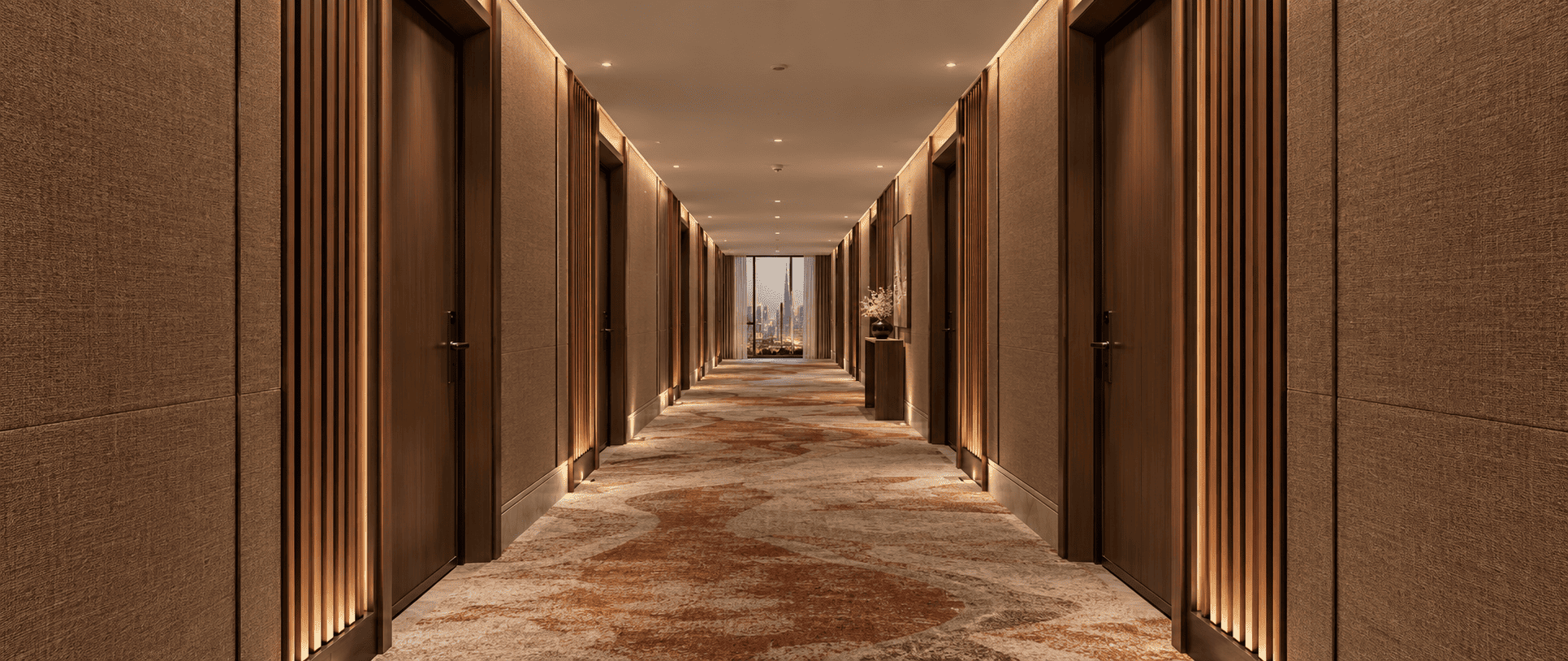
The Ramee Hotel in Dubai, UAE, is a 122 room city hotel with the acoustic profile that goes with that address. Urban traffic noise was reaching guestroom walls and windows, noise was transferring between adjoining rooms and from the corridors, and every material specified had to be ASTM compliant and fire rated to satisfy UAE hospitality approvals. The brief was luxury grade privacy in a building that never gets quiet outside.
The solution worked on all four paths at once. SoundBlanket MLV at 4 mm, STC 34, was installed within the partitions to block airborne noise between rooms. BassBloc at 20 mm, NRC 0.85, went into the walls to damp low frequency vibration. EPDM perimeter seals and bottom sweeps closed the room doors onto the corridor, which on a hotel floor is where privacy is normally lost. High density soundproof curtains blocking 80 per cent of external traffic noise handled the window wall.
The result was guestroom partitions performing at STC 50 and above, exceeding UAE hospitality acoustic norms, with measurably quieter rooms and improved privacy ratings from guests.
On hotel work the corridor door decides the outcome more often than the party wall does. A partition built to STC 50 sitting behind an unsealed door delivers the door, not the wall.
Why a Qatar banquet hall sounded worse when it was full
A luxury hotel banquet hall in Qatar had the opposite problem. Nothing was leaking in. The hall itself, with its high ceiling and hard finishes, was holding on to sound long after it was made, and during weddings and conferences speech became unusable once a few hundred people were talking at once.
That is a reverberation problem, and it is solved with absorption area rather than mass. Fabric wrapped acoustic panels at NRC 0.90 were installed across the side walls. SoundBlanket MLV at 4 mm went in behind the partitions to isolate the hall from noise in the adjacent service corridors, which in a banquet venue is a constant intrusion during service. Acoustic fabric curtains were used to let the hall be reconfigured between event formats without losing its acoustic character.
Reverberation time, RT60, came down from 2.4 seconds to 1.2 seconds. At 2.4 seconds a speech from a podium arrives as an overlapping wash. At 1.2 seconds it is intelligible from the back of the room.
How a European headquarters reached Rw 55
A corporate headquarters in Europe needed speech privacy at STC 55 and above in executive offices and boardrooms, which is a level at which a raised conversation should not be intelligible in the adjacent room. European projects are assessed against EN ISO 717-1 rather than the ASTM route, so the design had to satisfy an Rw 55 rating on test.
The wall assemblies combined SoundBlanket MLV at STC 34 with BassBloc at NRC 0.85 and double drywall, which is the standard way to reach that level without building a masonry wall in a fitted out office. Fabric panels at NRC 0.90 were installed in the meeting rooms for echo control, and wooden slat diffusers were added in the conference halls to scatter rather than absorb, so the rooms stayed lively enough for presentation without becoming reflective.
The project achieved full compliance with EN ISO 717-1 at Rw 55, delivering the speech confidentiality the client needed at board level.
A Saudi plant office with 90 dB on the other side of the wall
At an automotive plant in Saudi Arabia, the administrative offices sat inside a production building with a machinery floor running at over 90 dB. The requirement was an office that met occupational compliance and was usable for normal work, without moving the offices out of the building.
BassBloc at 20 mm provided vibration damping inside the partition cavities, which is the layer that deals with the structural hum a plant frame transmits. SoundBlanket MLV at 4 mm provided the airborne noise barrier against the floor. Acoustic ceiling panels at NRC 0.90 were used to control the interior, since a hard box next to a machine shop amplifies whatever does get in. Office noise came down to below 45 dB, meeting OSHA compliance and producing a work environment that the administrative teams could actually use.
Why an airport terminal spends its budget on the ceiling
An airport terminal in the Middle East had an intelligibility problem in its high traffic concourse. Announcements were not being understood, which in a terminal is a passenger flow and safety issue before it is a comfort one. Adding more amplification to a reverberant concourse makes it worse, not better, so the work had to reduce reverberation instead.
Perforated metal panels at NRC 0.70 with mineral wool backing were installed on the ceilings, which is where the largest uninterrupted surface area sits and where a material has to survive decades of public use. Echsorbix felt wall panels, NRC 0.30 at 9 mm to 0.60 at 24 mm, were added in the waiting zones to reduce echo at seated level. Reverberation was reduced by 50 per cent, and PA clarity and passenger comfort improved accordingly.
What repeats across all five
Different sectors, different standards, and one consistent pattern. Isolation projects are built from mass plus damping plus sealed openings, and the openings are where the rating is usually lost. Absorption projects are decided by how much effective area is treated and where it sits, not by how impressive the material looks. The same small group of products serves all of it, which is what makes multi country supply practical.
| Material | Rating | Typical use |
|---|---|---|
| SoundBlanket MLV | STC 30 to 34 | Airborne barrier in hotel, office and plant partitions |
| BassBloc | NRC 0.85 to 0.95 | Low frequency damping and vibration control in cavities |
| Echsorbix felt panels | NRC 0.30 at 9 mm to 0.60 at 24 mm | Wall finish and echo control in offices and public areas |
| Fabric wrapped acoustic panels | NRC 0.90, 50 mm rockwool core | Banquet halls, boardrooms and meeting rooms |
| Wooden slat panels | NRC 0.60 to 0.75 | Diffusion and finish in conference halls and auditoria |
| Perforated metal panels | NRC 0.70 | Ceilings in airports and transport hubs |
What to send before an export enquiry
Projects outside India move fastest when the technical position is settled before commercial terms are discussed. Tell us which standard the work will be assessed against, ASTM or EN ISO, because that decides whether the target is stated as STC or Rw. Send the partition and ceiling details, the room schedule with areas, and any acoustic consultant's report that exists. Say which approvals the material must satisfy locally, since fire and hospitality approvals in the Gulf often drive the specification harder than the acoustic target does. With those in hand we can issue test reports, datasheets, a layered build up and an export ready BOQ, and support the contractor through installation.
Products used in this article
Specifications and technical data on each product page. Smaller quantities ship from our online store.
- SoundBlanket Mass Loaded Vinyl STC 30 at 2.5 mm, STC 34 at 4 mm
- BassBloc Sound Absorber NRC 0.85 to ASTM C423, 20 mm and 40 mm
- Fabric Wrapped Acoustic Panels NRC 0.90, 50 mm rockwool core
- Echsorbix PET Felt Panels NRC 0.30 at 9 mm to 0.60 at 24 mm
- Wooden Slat Acoustic Panels NRC 0.60 to 0.75
- SoundBlanket Soundproof Curtains 4500 GSM, STC 30, NRC 0.20
- EPDM Perimeter Seals and Door Sweeps Self-adhesive, closes the door gap
Visit Online Store opens mmtacoustixonline.com in a new tab. For project quantities, BOQ support or export orders, use the quote form.