
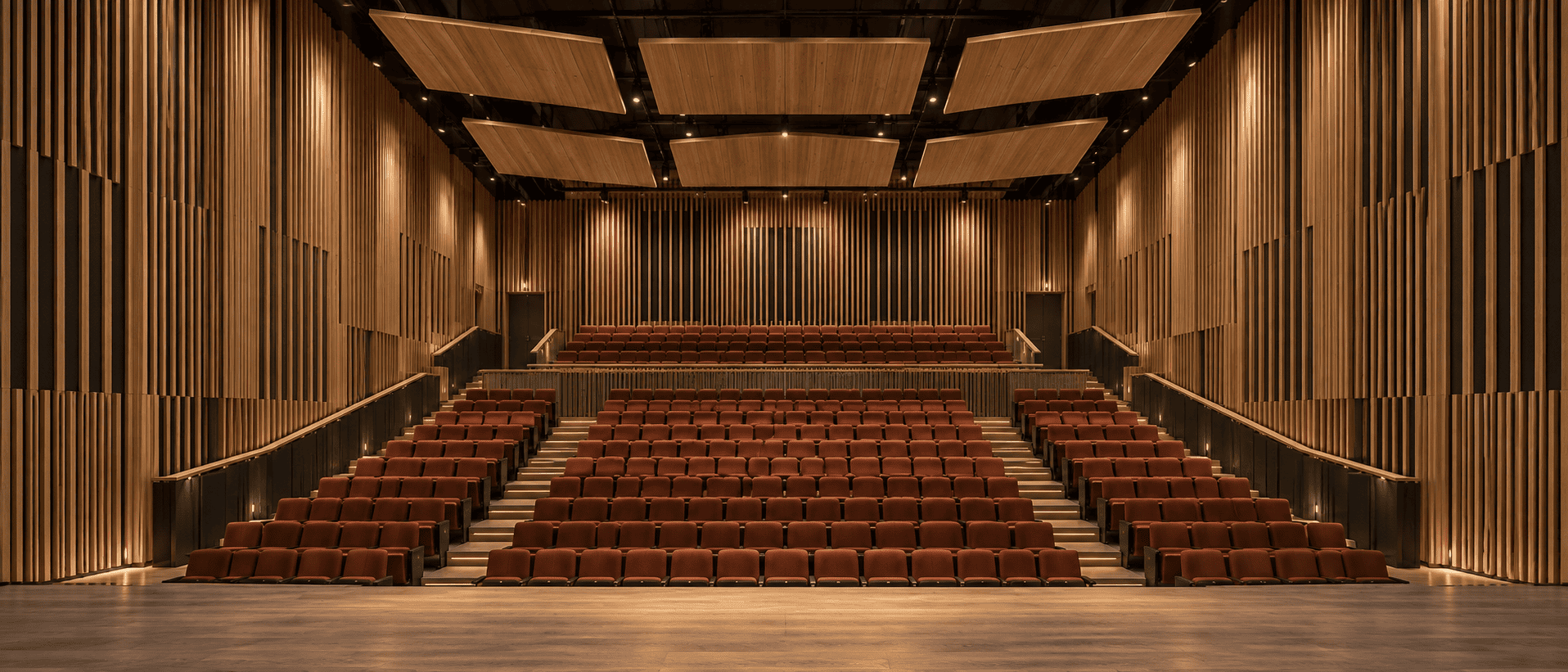
Auditorium acoustics
Acoustic Design in Auditoriums
Why the best-sounding halls scatter sound rather than swallow it, and how to specify slat panels so the finish and the acoustics arrive together.
Walk a 400-seat auditorium during commissioning and you learn more in ten minutes than in a week of drawings. Stand at row three, centre, and the speech is fine. Walk to the last row under the balcony and the consonants go soft. Walk to the side aisle near the rear wall and you hear the talker twice, once direct and once a beat later off the flat plaster behind you. Same room, same microphone, three completely different experiences.
That is almost never a loudspeaker problem. It is a geometry problem, and it is the reason wooden slat panels ended up as the default finish in serious halls rather than a purely decorative choice.
Why more absorption is the wrong first instinct
The instinct when a hall echoes is to add absorption until the echo stops. It works, in the sense that the reverberation time falls. It also strips the room of the early reflections that carry a talker's voice to the back rows and give an unamplified instrument its body. Over-absorb an auditorium and you get a space that is technically quiet and horrible to perform in, where every performer complains that they cannot hear themselves and the sound system has to work far too hard.
An auditorium needs clear speech intelligibility, balanced music reproduction and controlled reverberation at the same time. Those three requirements pull against each other. The way out is to stop treating the wall as a single decision between hard and soft, and start controlling where the reflected energy goes and how much of it survives.
What happens when sound reaches a slatted surface
A flat, hard wall returns a reflection as a coherent copy of the original, arriving at one place with one delay. That is what creates flutter echo and the dead spots and hot spots people report when they walk a hall.
A slatted surface behaves differently. The wave meets a repeating pattern of solid timber and open groove, so part of the energy is scattered across a spread of angles instead of being sent back as a single plane wave, and part passes through the groove into the cavity and the absorptive backing behind. The reflection that does return is broken up and lower in level, but it is still there. That is the trick: the room keeps the natural warmth that makes speech and music sound alive, and loses the coherent slap that makes it unintelligible.
Wooden acoustic panels in slat form give you both behaviours from one surface, which is why they suit rear walls and side walls, the two places in a hall where flat finishes cause the most damage.
Diffusion and absorption are not competing choices. A rear wall that only absorbs kills the sense of the room. A rear wall that only reflects sends a distinct echo back to the stage. The slat and cavity assembly is a controlled mixture of the two, and the mixture is set by the groove pattern and what sits behind it.
What to check on a slat panel datasheet
Most slat panels look identical in a photograph. The differences that matter are the core density, the groove pattern and what the panel is expected to do acoustically on its own.
| Property | Specification |
|---|---|
| NRC | 0.35, diffusion focused, increases with acoustic backing |
| Core material | High-density MDF or laminated wood veneer |
| Density | 800 kg/m3 |
| Thickness options | 12, 14, 16 and 18 mm |
| Panel size | 2400 x 128 mm, customisable |
| Groove patterns | M14/2, M13/3, M28/4 |
The NRC of 0.35 is the number people misread most often. It is low because a bare slat panel is not primarily an absorber, and a consultant who specifies it expecting a soft finish will be disappointed. Paired with an acoustic backing such as BassBloc or mineral wool, the same panel delivers NRC ratings of 0.60 to 0.75, which is the range you actually want for controlled reverberation in a hall. The panel is half of a system, and the datasheet only describes half.
The groove patterns are the tuning control. M14/2, M13/3 and M28/4 change the ratio of solid timber to open groove, which shifts the balance between scattering and absorption. A wider open ratio lets more energy into the backing and absorbs more; a tighter pattern scatters more and preserves more of the reflected field. On most projects the rear wall and the side walls end up on different patterns for exactly this reason. The 800 kg/m3 density matters because a limp panel rattles and colours the sound; rigidity is what keeps the timber acting as a reflector rather than a membrane.
What the Jaquar auditorium at Manesar needed
The corporate auditorium at the Jaquar headquarters in Manesar had to do two jobs that usually want different rooms. It hosts corporate presentations, which want a short, dry, highly intelligible acoustic, and live performances, which want a longer, warmer one. Splitting the difference badly would have produced a hall that did neither.
-
Surface strategy
M14/2 groove wooden slat panels on the rear and side walls, the surfaces responsible for the late reflections that were going to cause the intelligibility problems.
-
Acoustic backing
BassBloc at 20 mm, NRC 0.85, integrated behind the panels to absorb the low-frequency energy passing through the grooves and control resonance in the cavity.
-
Verification
The finished hall measured an RT60 of 1.2 seconds, which held speech clarity for presentations while leaving enough reverberant support for live performance.
What sits behind the wood
The slat panel is the visible layer of an assembly that usually has two or three others, and the others do the jobs timber cannot.
- Isolation layer: SoundBlanket MLV, STC 30 at 2.5 mm and STC 34 at 4 mm, installed behind the wall build-up to block external noise before it enters the hall.
- Low-frequency layer: BassBloc, NRC 0.85, in 20 mm and 40 mm, concealed behind the slats to take out the low-end energy that a timber surface will not touch.
- Ceiling: Ceiling baffles or suspended clouds, which add absorptive area in large-volume halls where the wall surfaces alone cannot bring the reverberation time down.
- Finish options: natural veneers, laminates and premium stains in walnut, oak and teak, so the acoustic layer and the architectural intent are the same decision rather than two.
Slats also take linear grooves, perforated designs or hybrid layouts, and can be set out around lighting tracks and HVAC grilles rather than fighting them. Plan that early: a slat run interrupted by an unplanned diffuser is visible from every seat in the house.
Where to start on an auditorium fit-out
Begin with the room volume and the seat count, not with a panel selection. Those two numbers give you a target reverberation time, and the target tells you how much absorptive area the hall needs in total. Only then does it make sense to decide which surfaces carry slats, which carry a backing behind them, and which are left hard to keep useful early reflections alive.
Next, fix the rear wall. It is the single surface most likely to send a distinct echo back to the stage, and it is where slat panels with a full absorptive backing earn their place fastest. After that, deal with isolation: if road traffic, a plant room or an adjacent banquet hall shares a structure with the auditorium, no internal treatment will rescue it, and the MLV layer has to go in before the finishes.
Send us the hall section, the seat count and the intended programme mix, and we will come back with panel quantities, groove pattern per surface and the backing build-up. It is a much cheaper conversation than discovering the problem at commissioning with a full house waiting.
Products used in this article
Specifications and technical data on each product page. Smaller quantities ship from our online store.
- Wooden Slat Acoustic Panels NRC 0.35, 800 kg/m3, 2400 x 128 mm
- BassBloc Sound Absorber NRC 0.85 to ASTM C423, 20 mm and 40 mm
- SoundBlanket Mass Loaded Vinyl STC 30 at 2.5 mm, STC 34 at 4 mm
- Acoustic Ceiling Baffles and Clouds Suspended absorption for large-volume halls
Visit Online Store opens mmtacoustixonline.com in a new tab. For project quantities, BOQ support or export orders, use the quote form.