
Transport hubs
Airport Noise Control: How Perforated Metal Panels Reduce Reverberation
How a perforated metal ceiling brings a terminal's reverberation under control without softening the architecture.
Watch a gate announcement land in an untreated terminal. The message plays, and almost nobody moves. A second later heads turn towards the flight information screens, because reading the gate number is easier than decoding it. The public address system is working perfectly. The room is the problem.
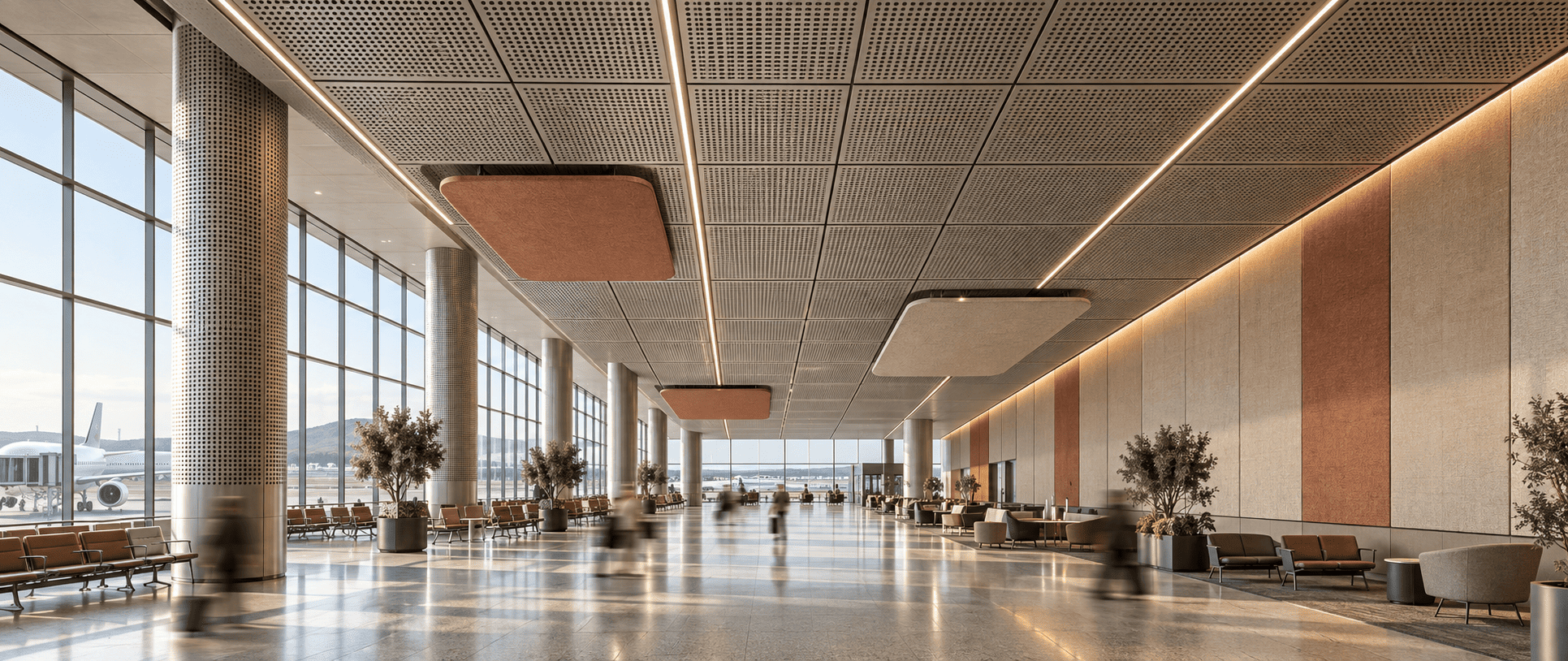
Terminals are built from glass, steel and stone across volumes of tens of thousands of cubic metres. Those materials give the building its light and its longevity, and they reflect very nearly all the sound that hits them. The energy stays in the hall, arriving at each passenger many times over. Speech intelligibility collapses, the ambient level rises as people talk over the echo, and passenger stress follows.
What a 2.8 second tail does to a gate announcement
Reverberation time, usually quoted as RT60, is the time a sound takes to decay by 60 decibels after the source stops. In a hard-surfaced concourse it can sit near 2.8 seconds. Speech in English runs at roughly three to five syllables a second, so at that decay rate each syllable is still audible when the next four arrive on top of it. Consonants, which carry most of the meaning and almost none of the energy, are buried under the vowels that came before them.
This is why turning the PA up does not help. More level puts more energy into the same reverberant field and the ratio between the direct sound and the tail stays where it was. The only fix that works is to remove reflected energy from the room, which means absorbing area, installed on surfaces that in an airport are mostly overhead.
The holes are not the absorber, the cavity behind them is
A perforated metal acoustic panel looks like a solid architectural finish, and acoustically it behaves like an open one. The micro-perforations, typically 1 to 3 mm, let the sound pressure pass through the facing with very little reflection. What it meets behind the facing is a high-density mineral wool or foam infill, and that is where the energy is absorbed and dissipated as heat. The metal contributes strength, cleanability and appearance, and stays out of the acoustic path.
The consequence is that the absorption figure belongs to the assembly, not to the sheet. A perforated panel with no infill behind it is decoration. The same panel with a proper acoustic backing reaches NRC 0.70, and in a terminal with several thousand square metres of ceiling, that difference is what brings RT60 down to a level where announcements are understood the first time.
What the panel is made of, and why each layer is there
| Property | Specification |
|---|---|
| NRC | 0.70 with acoustic infill |
| Panel size | 2 x 2 ft, custom sizes available |
| Thickness | 1 inch with mineral wool backing |
| Material | Powder-coated steel or aluminium |
| Fire rating | Class A, non-combustible |
| Perforation | Micro-perforations, custom patterns |
Every line in that table earns its place in an airport. The Class A, non-combustible rating is a condition of public infrastructure compliance, certified to the applicable ASTM, EN and ISO standards. Powder-coated steel or aluminium takes trolley strikes, cleaning chemicals and twenty years of service without shedding fibres, which matters in a hygiene-sensitive building where a fibrous exposed finish would not be accepted. The 2 x 2 ft module drops into standard suspended grid so the ceiling can be opened for services without cutting anything.
Specify the infill and its retention explicitly, not just the facing. A tissue-faced mineral wool pad, securely held so it cannot sag or migrate over the life of the ceiling, is what delivers the tested figure. Panels ordered on perforation pattern alone are a common route to a ceiling that looks right and measures badly.
Ceilings before walls, and why
In most terminals the ceiling is the only large surface that is neither glazed, nor structural, nor covered in retail. It is also parallel to the floor, which makes it half of the flutter path that does the most damage to intelligibility. Treat it first and the rest of the building gets easier.
- Ceilings: suspended grid systems across terminals and lounges, the primary absorbing area in the building.
- Walls: acoustic cladding behind check-in counters and boarding gates, where clear speech between staff and passengers is the actual operational requirement.
- Baggage areas: panels to hold down mechanical noise from handling equipment and the crowd chatter that builds on top of it.
- Lounges: perforated metal blended with wood or fabric finishes, where the acoustic target is comfort and quiet conversation rather than PA clarity.
In lounges, wooden slat panels and fabric wrapped panels at NRC 0.90 take over from metal, because the traffic is lighter and the brief calls for warmth. The acoustic principle does not change, only the facing that sits in front of the absorber.
Reverberation control is not noise control
An absorbing ceiling reduces the sound that circulates within a hall. It does not stop runway noise, plant rooms or baggage handling from entering it. Those are transmission problems and they are solved in the construction, which means they have to be dealt with before the ceiling grid is hung.
-
Block what comes from outside
SoundBlanket mass loaded vinyl goes into the walls at STC 30 to 34, adding dense, limp mass to the envelope separating passenger areas from aprons, plant rooms and baggage halls. It works only if the perimeter and every service penetration are sealed, because airborne noise finds gaps before it finds mass.
-
Take out the low frequencies while the build-up is open
BassBloc at NRC 0.85 is concealed in ceilings and wall build-ups to absorb the low-frequency energy from ground equipment, conveyors and air handling plant. Once the ceiling is closed this option disappears.
-
Hang the absorbing ceiling
Perforated metal panels at NRC 0.70 in suspended grid, covering as much of the plan area as the services allow. This is the layer that changes RT60 and therefore intelligibility.
-
Add absorbing area where the ceiling is too high to reach
Suspended acoustic baffles and clouds work in tall atria and check-in halls where a flat ceiling would be forty metres above the passengers and acoustically irrelevant. Bringing absorption down closer to head height puts it in the path of the sound that actually matters.
A Middle East terminal, 2.8 seconds down to 1.4
An international terminal came to us with a familiar complaint from operations: announcements in the arrivals concourse were unclear, and passenger noise complaints were rising. Measured reverberation was 2.8 seconds.
Perforated metal ceiling panels with 50 mm mineral wool backing, NRC 0.70, were installed across the concourse, and acoustic wall cladding was added in the check-in and baggage claim areas where staff and passengers have to talk to each other. Reverberation came down to 1.4 seconds. Announcement clarity improved and the noise complaints fell away. The PA system was never modified.
What to do first in a live terminal
Measure before you specify. An RT60 measurement in the concourse, taken at a quiet hour, tells you how much absorbing area you actually need and gives you the number that proves the project worked afterwards. Without it you are buying panels on faith and will have no way to defend the spend.
Then audit the plan for available surface. Count the ceiling area not taken by services, signage and lighting, because that is your real budget of absorption, and it is usually smaller than the drawings suggest. Where it falls short, baffles make up the difference. Deal with the envelope and the plant-side walls before the ceiling contractor starts, since those layers are buried. And in the panel schedule, name the infill, the retention detail and the tested NRC beside the perforation pattern, so what is delivered is the assembly that was tested rather than the sheet that was drawn.
Products used in this article
Specifications and technical data on each product page. Smaller quantities ship from our online store.
- SoundBlanket Mass Loaded Vinyl STC 30 at 2.5 mm, STC 34 at 4 mm
- BassBloc Sound Absorber NRC 0.85 at 20 mm, concealed in the build-up
- Acoustic Ceiling Baffles and Clouds Suspended absorbing area for high-ceiling halls
- Fabric Wrapped Acoustic Panels NRC 0.90, 50 mm rockwool core
- Wooden Grooved Slat Panels Diffusive slat finish for lounges and premium interiors
Visit Online Store opens mmtacoustixonline.com in a new tab. For project quantities, BOQ support or export orders, use the quote form.