
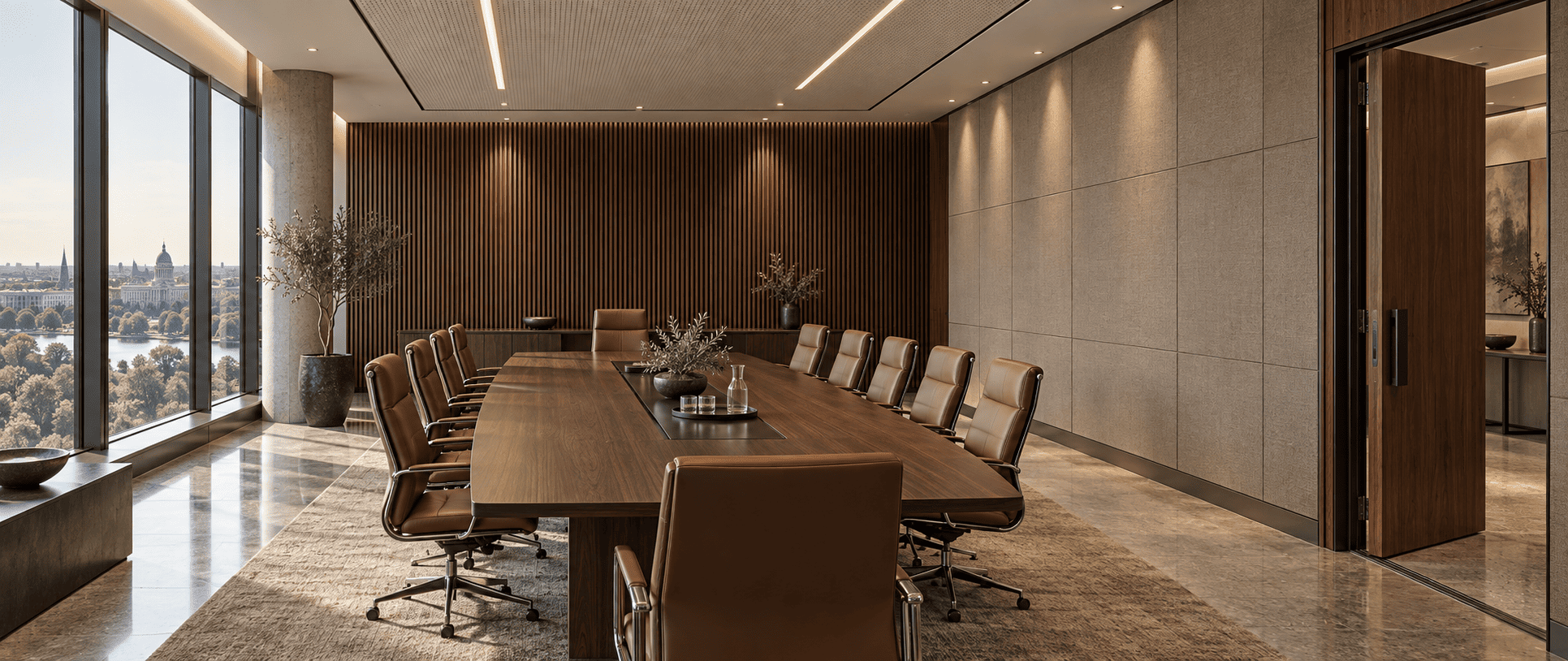
Institutional specification
Premium Government & Corporate Projects: Acoustic Standards and Solutions
What courtrooms, boardrooms, auditoriums and control rooms actually demand, and how a specification survives technical scrutiny.
A commissioning walkthrough in a new government office block usually ends at the same place. Someone stands in the corridor outside the senior officer's room while a colleague reads aloud inside, and everyone listens. If the words are intelligible in the corridor, the partition has failed, whatever the drawings said. On one project we attended the wall itself was competent. The failure was a gap under an expensive veneered door and a ceiling void running straight over the head of the partition.
Premium government and corporate work is unforgiving in that way. The brief is written in tested numbers, the materials are checked against certificates, and the result is verified by people standing in corridors.
Why a courtroom and a boardroom fail in opposite ways
A courtroom fails when the room itself defeats the spoken word. High volumes, stone and glass and a hard ceiling produce a long reverberant tail, so a witness at one end is unintelligible at the other and the record suffers. That is an absorption problem, solved on the surfaces you can see.
A boardroom fails the other way. The room is small, carpeted and comfortable, and speech inside it is perfectly clear. What goes wrong is that the speech is equally clear in the lobby. That is a transmission problem, solved inside the construction. Defence control rooms and secure offices sit in the same category, with equipment and HVAC noise to keep out as well.
Specifications for this sector therefore call for tested STC for isolation and tested NRC for echo control, from materials certified to ASTM, EN and ISO standards. Once that language is in the tender, every product has to arrive with paperwork.
Confidentiality, clarity, flexibility and fire
- Confidentiality: high-STC walls preventing speech leakage between government offices, boardrooms and security spaces, the requirement most often written and least often achieved.
- Speech clarity: optimised NRC in conference halls, parliamentary chambers and presentation spaces, where the room must support a voice rather than compete with it.
- Multi-functionality: auditoriums serving the spoken word and multimedia playback on the same day without being retuned.
- Compliance and fire safety: materials meeting ASTM E84, EN and ISO fire and acoustic standards, because these are public occupancy buildings.
Confidentiality is listed first deliberately. Absorption can be added to a finished room in a weekend. Isolation cannot, because it lives inside a wall already closed, decorated and handed over.
What actually goes into a compliant wall build-up?
The core of a high-STC partition is mass that does not stiffen the wall, a cavity that is damped rather than resonant, and a perimeter that is genuinely sealed. The products that deliver it go in before any finish is chosen.
-
Mass in the partition
SoundBlanket mass loaded vinyl provides STC 30 to 34 across the 2 to 10 mm range, supplied in 32 x 4 ft rolls so walls and ceilings can be covered with minimal jointing. It is the airborne noise barrier for courtrooms, government offices and corporate partitions, and the layer most often value-engineered out by people who do not know what replaces it.
-
Low frequency control inside the build-up
BassBloc is concealed within walls, ceilings and floors at NRC 0.85, in 20 mm and 40 mm grades. Its job is the low-frequency energy from HVAC plant and heavy equipment, which surface finishes do not touch.
-
The visible absorbing layer
Fabric wrapped acoustic panels with a mineral wool core reach NRC 0.90, tuned to speech absorption and available in over 20 fabric shades. They are the default finish for conference rooms, boardrooms and legislative chambers because they deliver a high absorption figure without dictating the interior design.
-
Diffusion where the room has to stay live
Wooden grooved slat panels at NRC 0.35 diffuse rather than deaden, and are backed with BassBloc or cavity insulation where more absorption is needed. Auditoriums, premium meeting halls and cultural centres use them to keep a room alive while controlling flutter, in an architectural-grade finish.
Perforated metal panels at NRC 0.70 complete the set: the durable, fire-safe option for transport hubs, large corporate lobbies and government complexes, where a fabric or felt finish would not survive the traffic.
Where each material belongs, from slab to door
Walls take the full stack: SoundBlanket MLV at STC 30 to 34, BassBloc within the build-up, and a fabric or felt finish on the room face. Ceilings in large public volumes take perforated metal panels or suspended acoustic baffles, which give you absorbing area where wall area is scarce and mostly glazed. Floors in multi-level facilities take an underlayment incorporating MLV, because footfall noise between storeys is a complaint that arrives after occupation and is almost impossible to fix then.
Doors deserve their own line in every BOQ. A partition rated in a laboratory is joined on site to a door leaf, a frame and a threshold, and the assembly is only as good as its gaps. EPDM perimeter seals on the frame with bottom sweeps at the threshold close that leakage path. On the commissioning walk described above, sealing the door and boxing the ceiling void changed the result more than any panel could have.
Speech privacy is decided by the weakest path, not the average one. A partition at STC 50 with an unsealed door, an open plenum above the head, or a continuous service duct will perform like a partition in the thirties. Detail the flanking paths at design stage and the wall will do what the certificate says.
Jindal Steels, New Delhi, 9,600 square metres of offices
The brief covered 9,600 m2 of executive offices and meeting spaces, with speech privacy in senior meeting rooms as the governing requirement. Walls were treated with SoundBlanket MLV at 4 mm, STC 34, BassBloc at 20 mm handled vibration and low-frequency transfer within the build-up, and premium fabric wrapped panels at NRC 0.90 finished the boardrooms.
The delivered partitions achieved STC 55 and above, and speech privacy improved to the point where the acoustic scope stopped being discussed. What made that possible was not a single product but that the barrier, the cavity treatment and the door detailing were specified as one system, and none of it was substituted during procurement.
Which numbers survive technical scrutiny?
Three test standards carry most of the weight on institutional work. ASTM E84 covers surface burning characteristics and is what a Class A fire claim rests on. ASTM C423, with EN ISO 354 as its international counterpart, is the reverberation room method behind every NRC figure. ASTM E90 is the laboratory method behind every STC figure, which is why STC is written as a plain index and never carries a decibel unit after it.
A specification that names the standard alongside the value is harder to undercut during procurement, because a cheaper product either has the same report or it does not. One that says only "acoustic panel, NRC 0.90" invites a substitution backed by a brochure. Insist on the thickness the figure was measured at, the mounting condition, and the laboratory that issued the report.
What to do first on a live tender
Before choosing any material, split the room schedule into two columns: rooms that need isolation and rooms that need absorption. Most need both, but one will govern, and that decides where the budget goes. Then walk the drawings for flanking paths, specifically the ceiling void over every partition, every door into a confidential space, and every duct crossing a rated wall. Fixing those on paper costs nothing.
Write the standard beside every performance figure in the BOQ, ask for test reports before award rather than at handover, and keep the barrier layer out of any value-engineering exercise. Absorption can be added to a room later. The wall cannot be rebuilt once the building is occupied.
Products used in this article
Specifications and technical data on each product page. Smaller quantities ship from our online store.
- SoundBlanket Mass Loaded Vinyl STC 30 at 2.5 mm, STC 34 at 4 mm, 32 x 4 ft rolls
- BassBloc Sound Absorber NRC 0.85 to ASTM C423, 20 mm and 40 mm
- Fabric Wrapped Acoustic Panels NRC 0.90, 50 mm rockwool core
- Wooden Grooved Slat Panels NRC 0.35, backed with BassBloc or insulation
- Acoustic Ceiling Baffles Suspended absorbing area for large volumes
- EPDM Perimeter Seals and Door Sweeps Self-adhesive, closes the door gap
Visit Online Store opens mmtacoustixonline.com in a new tab. For project quantities, BOQ support or export orders, use the quote form.