
Wall performance
Understanding STC Ratings and Their Role in Soundproofing Walls
What the number measures, what it quietly leaves out, and how to build a partition that meets the figure on the drawing.
A consultant once sent us a photograph of a boardroom partition with a note that read, in full, "specified STC 50, built as drawn, client can hear the sales meeting". The wall had been built as drawn: two layers of board each side, insulation in the cavity. What the detail did not show was the return air path over the ceiling, and that the partition stopped at the ceiling tile rather than the slab. The wall was close to its rating. The room was not.
That gap between a rated product and a performing room is where most soundproofing money is wasted, and understanding what STC is, and is not, is the cheapest way to avoid it.
Where does the STC number come from?
Sound Transmission Class comes from a laboratory test to ASTM E90. A specimen wall is built between two isolated chambers, a source is played on one side and the level is measured on both. The difference at each test frequency gives a transmission loss curve in decibels from 125 Hz to 4000 Hz, which covers speech and most common building noise.
That curve is compared against a standard reference contour, and the single number the process produces is the STC. It is an index, not a measurement in its own right, and it carries no unit. The rating is written as STC 34, never with a decibel unit appended: the decibels live in the transmission loss curve underneath, and the index is only its summary.
STC 50 does not mean 50 dB quieter
This is the most common misreading and it leads straight to disappointed clients. The index is a curve-fitting result, so it promises no particular reduction at any given frequency, and it certainly does not promise that a sound arriving at 70 dB will leave at 20 dB.
Two walls with the same STC can sound quite different in use, because one may hold its transmission loss evenly while the other dips badly in a single band. STC is also weighted towards speech and takes no account of what happens below 125 Hz, which is exactly where a subwoofer, a lift motor or a home theatre does its damage. A wall can be rated STC 55 and still pass the bass line from a party next door. Treat the index as a way of comparing assemblies and as a compliance target, not as a prediction of how many decibels the neighbour will lose.
What can people actually hear at each level?
The subjective descriptions are more useful on site than the arithmetic, because they are what the client judges by.
- STC 25: normal conversation is easily heard and understood through the wall.
- STC 35: loud speech is still audible, though not always intelligible.
- STC 50 and above: excellent privacy, with loud sounds barely perceptible.
Note how narrow that ladder is. Around twenty-five points separate a wall with no privacy from one with real privacy, and each additional point costs more than the one before it.
The numbers projects are usually held to
These are the levels most residential, corporate and hospitality specifications are written around.
| Space | Target | Driver |
|---|---|---|
| Apartments and shared walls | STC 50 and above | Neighbour noise |
| Bedrooms in urban homes | STC 45 to 50 | Night-time traffic |
| Corporate boardrooms | STC 55 and above | Speech confidentiality |
| Hotels and hospitals | STC 50 and above | Guestroom privacy |
| Studios and theatres | STC 55 to 60 and above | Leakage between rooms |
Mass, decoupling and damping do different jobs
A wall gets quieter through three mechanisms and they are not interchangeable. Mass resists being driven by sound pressure. Decoupling removes the rigid path that lets one leaf drive the other. Damping turns vibration in the panel into heat. A good partition uses all three, and the order matters, because each step changes what the next is worth.
-
Add dense, flexible mass
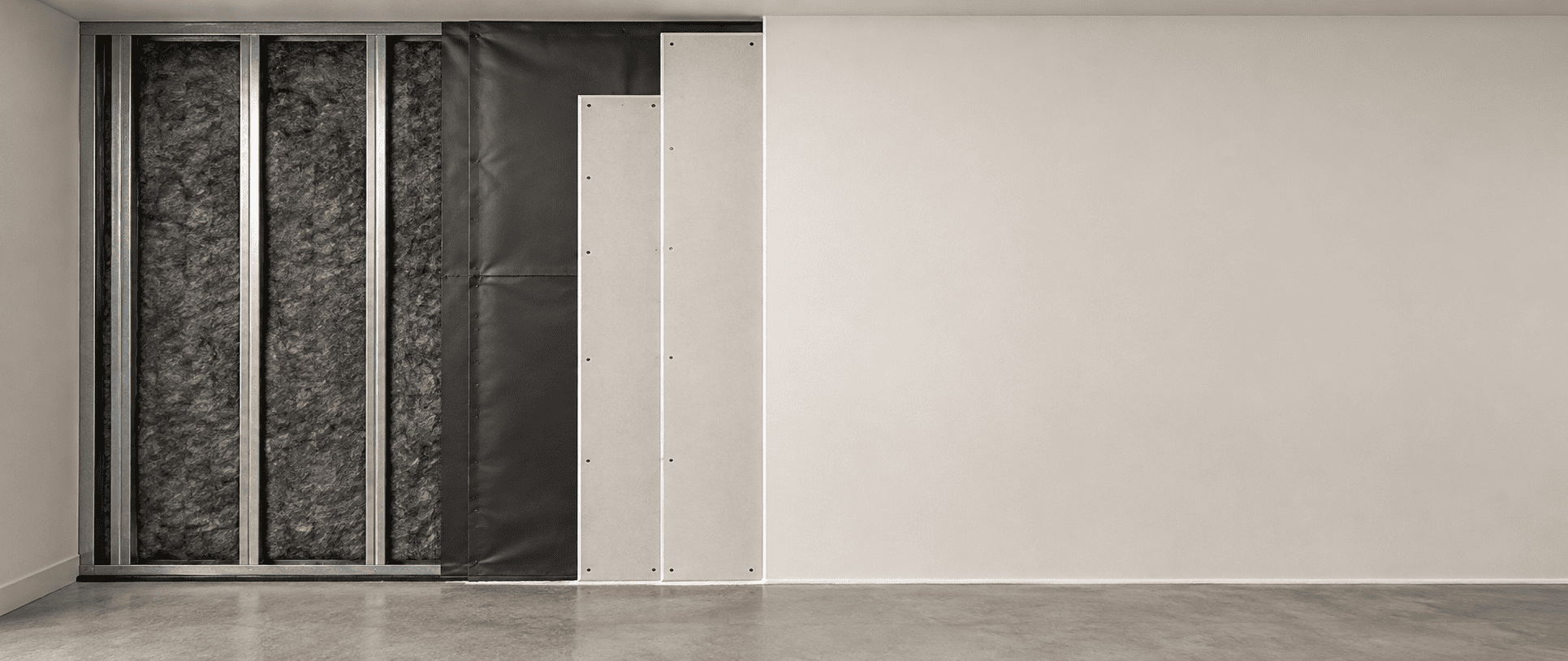
SoundBlanket mass loaded vinyl does this without rebuilding the framing. At 2100 kg/m3 it gives STC 30 at 2.5 mm and STC 34 at 4 mm, in 2.5 mm, 4 mm and 6 mm plus project-specific thicknesses, and ships in 32 x 4 ft rolls so a wall is covered with few seams. It is limp rather than rigid, which lets it add mass without introducing a new resonance.
-
Damp the low end
BassBloc sits behind the finish and targets the low-frequency energy that STC does not weight heavily but occupants notice immediately. It is rated NRC 0.85, supplied in 20 mm and 40 mm, and it is usually what decides whether a room feels quiet or merely measures quiet.
-
Decouple the leaves
Independent framing, double stud or staggered stud, removes the structural bridge between the two faces of the wall. Done properly this is worth 8 to 12 points on its own, more than any single material can buy.
-
Seal every opening
Sockets, conduit, ceiling voids and the door perimeter are where rated walls lose their rating, and one unsealed gap caps the whole assembly. EPDM perimeter seals and acoustic sealant at head, base and junctions are part of the acoustic design, not finishing items.
-
Finish the inside of the room
Absorptive finishes do not raise STC, but they lower the reverberant level building up against the wall. Echsorbix PET felt runs NRC 0.30 at 9 mm to 0.60 at 24 mm, and acoustic foam at NRC 0.90 goes further where appearance matters less.
Adding a second layer of the same board is the least efficient upgrade available. Doubling the mass of one leaf buys a few points, while decoupling that leaf or adding a limp barrier buys considerably more for less thickness.
What do real wall build-ups measure?
Three assemblies cover most of the projects we quote. A single-layer brick or cement wall, the default in most Indian apartments, sits at around STC 35, nowhere near enough for a bedroom on a party wall or for any premium project. Adding MLV and BassBloc behind drywall takes the assembly past STC 50, which satisfies hotel, office and apartment privacy requirements. Putting the same MLV and BassBloc into a double stud wall takes it past STC 55, the region studios, theatres and confidential boardrooms need.
A Gurgaon office that needed real speech privacy
An executive office suite in Gurgaon had a straightforward complaint: speech from the adjacent office was audible during meetings, which for that client was a commercial risk rather than an annoyance. The existing partition was a conventional gypsum build with nothing dense in it.
The remedy was undramatic. SoundBlanket MLV at 4 mm, rated STC 34 on its own, went behind the gypsum partitions, and BassBloc at 20 mm was added for vibration damping. The composite wall achieved STC 54 and speech privacy was complete. No framing was rebuilt and almost no floor area was lost, because the gain came from what went into the existing cavity rather than from a thicker wall.
What should you check before you specify?
Start by asking what the wall has to stop, not what number the drawing says. If it is speech, STC is the right index and the targets above apply. If it is music or machinery, the STC target is necessary but not sufficient, and low-frequency damping and decoupling belong in the design from the outset rather than after a complaint.
Then follow the wall from slab to slab and list every place sound can go around it: the ceiling void, the raised floor, a shared duct, a back-to-back socket, the door. Fix those first, because they cap everything else. Only then choose materials, and ask for the ASTM E90 report for the exact assembly rather than for a product on its own. A number quoted for a bare material is a starting point, not a wall.
Products used in this article
Specifications and technical data on each product page. Smaller quantities ship from our online store.
- SoundBlanket Mass Loaded Vinyl STC 30 at 2.5 mm, STC 34 at 4 mm, 32 x 4 ft rolls
- BassBloc Sound Absorber NRC 0.85 to ASTM C423, 20 mm and 40 mm
- EPDM Perimeter Seals and Door Sweeps Self-adhesive, closes the door gap
- Echsorbix PET Felt Panels NRC 0.30 at 9 mm to 0.60 at 24 mm
- Acoustic Foam, Galaxy, Pyramid and Curve NRC 0.90, 6 x 3 ft sheets or 1 x 1 ft tiles
Visit Online Store opens mmtacoustixonline.com in a new tab. For project quantities, BOQ support or export orders, use the quote form.