
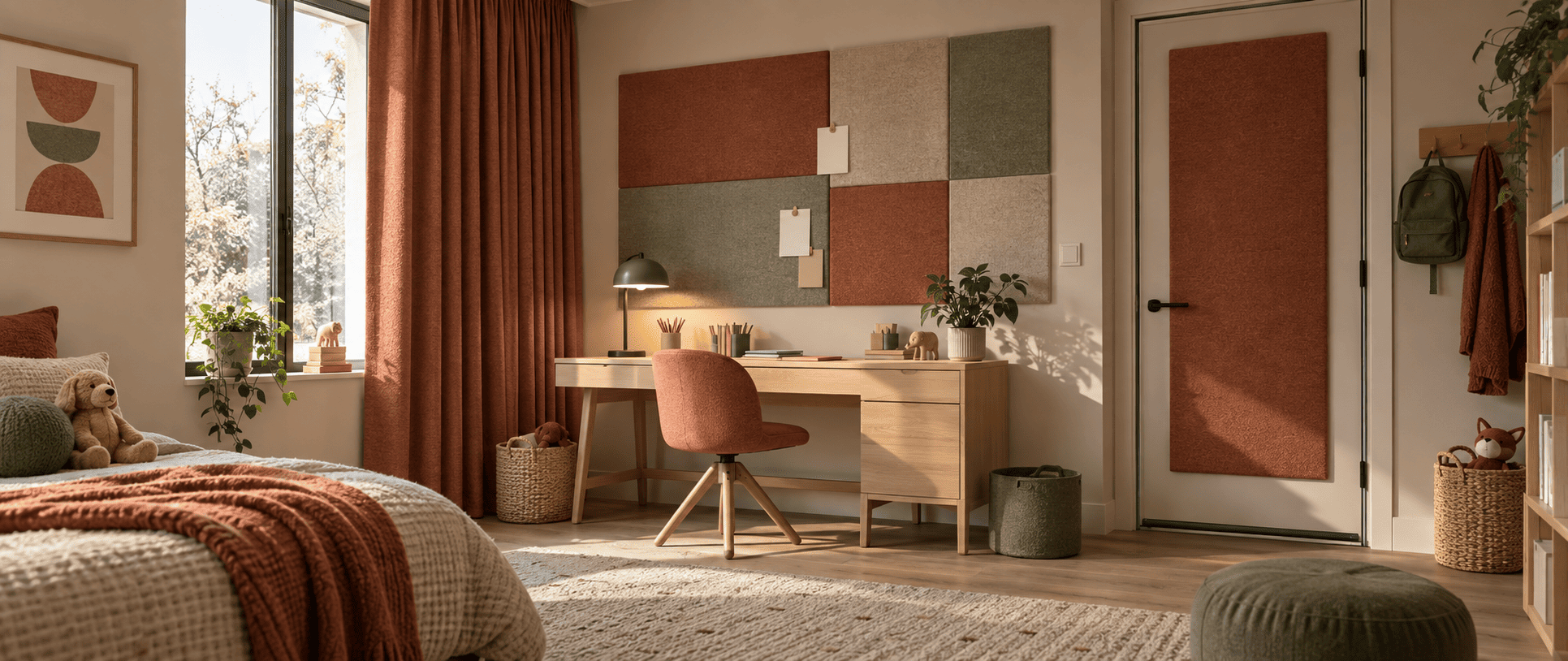
Study room acoustics
Quiet Kids’ Study Rooms: Acoustic Curtains & Simple Soundproofing Hacks
A practical order of work for a small room, starting with the window and ending with the wall.
A parent in Pune sent us a recording of an online class. You could hear the teacher, faintly, and over the top of her a motorcycle, a horn, a television from the next room and the child asking, for the third time, whether anyone else had heard the question. The room was clean, well lit and well furnished. It was also 9 feet from a busy street, had a hollow door onto the living room, and had four hard plastered surfaces and a glass window.
That combination is ordinary, and so is the response to it. Most families start by moving the desk, then buy thick curtains from a furnishing shop, then give up. The order of work matters far more than the spend, because in a small room the cheap measures are also the effective ones, provided you do them in the right sequence.
What breaks a child's concentration first?
Not volume. Intelligibility. A steady hum of traffic is much easier to work through than a half-audible conversation from the next room, because the brain keeps trying to resolve speech it can nearly understand. This is why a room that measures reasonably quiet can still be useless for homework, and why treating the room for echo, which makes speech inside it clearer and speech outside it less distinct, is not a cosmetic step.
It also tells you where to look. Anything carrying voices, the door to the living room, a shared wall, a window facing a street where people talk, deserves attention before anything else.
Start at the window, because that is where the road is
In almost every study room we survey, the window is the largest weak point and the quickest thing to improve. Acoustic curtains are not the heavy drapes sold as blackout: they are a multi-layer, heavy-duty 4500 GSM construction rated STC 30 with NRC 0.20, and they block up to 80% of external traffic sounds.
- Coverage decides the result: hang them wall to wall and ceiling to floor. A curtain that stops at the window reveal leaves the leak it was bought to close.
- Light control comes free: the same construction cuts glare on a screen, which matters during online classes.
- Finish: available in multiple shades, so the room does not have to look like a treatment.
- Retrofit friendly: nothing is opened up, nothing is permanent, and the change is audible the same day.
Why sealing beats spending
After the window, the gaps. A 5 mm gap under a door passes a surprising amount of sound, and no amount of panel on the wall will compensate for it. Work through these in order, because each one is cheap and each one makes the next measurable.
-
Tape the door frame
EPDM door tape fills the gap around the frame on all three sides. It is self-adhesive and goes on in twenty minutes with no tools.
-
Close the bottom of the door
A bottom door seal in metal and vinyl adds roughly 3 dB to the door's insulation and cuts the hallway and living room noise that travels along the floor. This is the single best value item in the room.
-
Seal the window frame
Flexible silicone acoustic seals give an airtight closure around the frame, which stops the whistle on a windy evening and finishes the job the curtain started.
Felt or foam above the desk?
With the leaks closed, the room's own reflections become the limiting factor. In a small study room you are aiming to cover 20 to 30% of the wall area, concentrated around the desk and on whichever wall the noise arrives through. Beyond that you are spending money to make the room sound dead rather than calm.
Echsorbix PET felt panels are the usual specification for a child's room. They run NRC 0.30 at 9 mm to 0.60 at 24 mm, come in colours such as Ash Grey and Olive, and have a soft texture that survives being lived with. They also take pins directly, so the board above the desk becomes the place for a timetable and revision notes rather than another decorative object.
Where the room is small and echoey and the finish matters less, acoustic foam at NRC 0.90 absorbs more per square foot, in Galaxy with its concave profile, Pyramid or Curve. It is the stronger absorber; felt is the better fit for a bedroom that doubles as a study.
Clap once in the middle of the room before and after the panels go up. If the clap still rings, the surfaces are still too hard. If it stops dead, you have gone too far and the room will feel oppressive to sit in for two hours.
When the wall itself has to be upgraded
Curtains, seals and panels solve most study rooms. They will not solve a room on a heavy traffic road or one sharing a wall with a loud neighbour, because those are barrier problems and need mass. In that case the wall gets rebuilt in three layers: SoundBlanket MLV at 4 mm (STC 34) as the dense barrier against traffic and television noise, BassBloc at 20 mm (NRC 0.85) behind it to take the low-frequency vibration, and felt or foam on the face as the interior finish.
This is a proper job with dust and a contractor, and it is worth doing only after the cheaper measures have been tried and found insufficient. It is also worth doing once rather than twice, so plan the whole build-up before the first sheet of drywall comes off.
What a Pune study room needed
The room from the recording at the top of this article belonged to a ten-year-old, faced a busy street, and was disrupting online classes daily. The work took a day. Acoustic curtains at 4500 GSM went across the full window wall, EPDM door seals and bottom sweeps closed the door to the living room, and Echsorbix felt panels rated NRC 0.30 to 0.60 by thickness went up above the study desk.
Outside noise dropped by around 12 dB. No wall was opened and no window was replaced. The parents' own summary was that the child stopped asking the teacher to repeat things.
What should you do first?
Sit at the desk at the hour the room is actually used, with the door shut, and listen for two minutes. Note whether what reaches you is traffic, household noise through the door, or voices through a wall. If it is traffic, hang the curtain and seal the window frame. If it is the household, tape the door and fit the bottom seal before anything else. Only if voices come through the wall itself does the conversation move to MLV and BassBloc. Treat 20 to 30% of the wall area with felt in either case, then stop and listen again before spending more. Most study rooms are finished by then.
Products used in this article
Specifications and technical data on each product page. Smaller quantities ship from our online store.
- SoundBlanket Soundproof Curtains 4500 GSM, STC 30, NRC 0.20
- EPDM Perimeter Seals and Door Sweeps Self-adhesive, closes the door gap
- Echsorbix PET Felt Panels NRC 0.30 at 9 mm to 0.60 at 24 mm
- Acoustic Foam, Galaxy, Pyramid and Curve NRC 0.90, 6 x 3 ft sheets or 1 x 1 ft tiles
- SoundBlanket Mass Loaded Vinyl STC 30 at 2.5 mm, STC 34 at 4 mm
- BassBloc Sound Absorber 20 mm, NRC 0.85, behind the wall finish
Visit Online Store opens mmtacoustixonline.com in a new tab. For project quantities, BOQ support or export orders, use the quote form.