
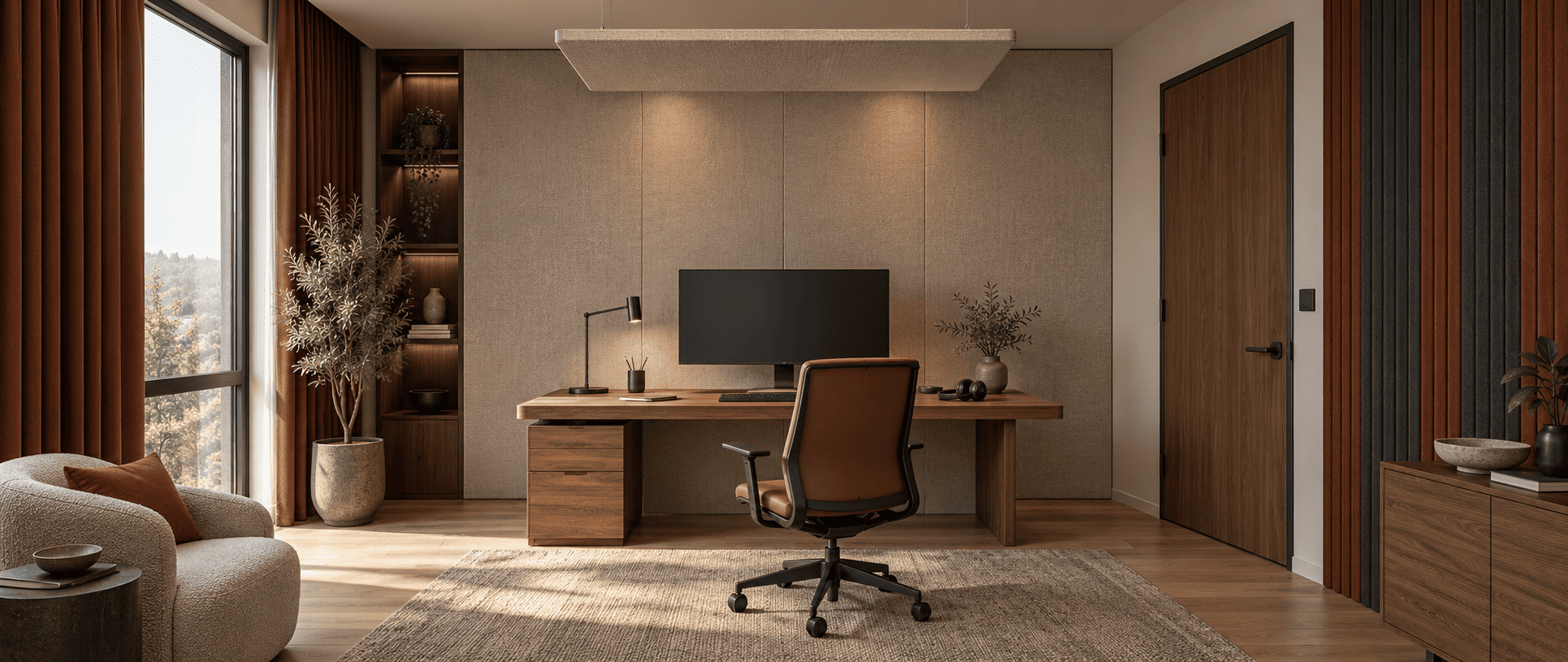
Acoustics for remote work
Soundproofing a Home Office for Remote Work
Why your voice sounds worse at home than it did at the office, and the order in which to fix it.
Someone on the call says you cut out. You did not cut out. The connection was fine, the microphone was fine, and you were speaking normally. What they heard was your room.
This is the part of remote work nobody budgeted for. A spare bedroom was never designed to be a broadcast space, and it behaves like what it is: four hard walls, a window onto a road, a door onto a corridor where the rest of the house is going about its day. Two separate things are going wrong at once, and most people try to fix them with the same product.
Why does the same laptop sound worse at home?
Walk into a corporate meeting room and look up. Mineral fibre ceiling tiles. Carpet underfoot, fabric on the chairs, a partition behind you. None of it was put there for your voice, but all of it is absorbing sound, which is why you sounded competent on calls without ever thinking about it.
Now look at the room you are working in. Plaster walls, a tiled or wooden floor, a glass window, a desk. Your microphone picks up your voice, and then picks it up again a few milliseconds later off every hard surface in the room. Those arrivals smear together. That is the hollow, far-away quality people describe as sounding like you are in a bathroom, and it is the reason a better microphone does not help. The microphone is doing its job perfectly. It is faithfully recording a reverberant room.
Blocking noise and absorbing echo are different jobs, solved by different materials. Dense and heavy stops sound getting in. Soft and open stops it bouncing around once it is in. Neither substitutes for the other.
What is actually reaching your desk?
Before buying anything, separate the two problems, because the order matters and getting it wrong is expensive.
The first is isolation: traffic, neighbours, the doorbell, a television two rooms away. This is airborne noise arriving from outside the room, and the only thing that reduces it is mass and sealing. The second is absorption: your own voice, reflected. This is generated inside the room and is fixed with soft, porous material on the surfaces the microphone can hear.
Panels on the wall do nothing for the first problem. This is the single most common mistake in home office acoustics: someone spends on foam or felt, the room sounds tighter on the recording, and the motorbike outside is exactly as loud as it was.
How much mass does a wall actually need?
Mass Loaded Vinyl is the workhorse here. It is a dense, flexible sheet that goes into the wall build-up, behind drywall, cement board or gypsum, and adds the weight a lightweight partition never had. SoundBlanket runs at 2100 kg/m³ and comes in 32 by 4 ft rolls, 10 m by 1.2 m, so a wall is covered in continuous runs with few seams. It carries a Class A fire rating, which matters once it is enclosed.
| Thickness | STC | Where it fits |
|---|---|---|
| 2.5 mm | 30 | Quiet residential streets, internal partitions |
| 4 mm | 34 | Urban homes, shared walls, roadside offices |
| 6 mm and above | Test report on request | Premium isolation, studio-grade work |
The jump from 2.5 mm to 4 mm is small on paper and clearly audible in practice, particularly on the low rumble of traffic that thin walls pass straight through. If the office shares a wall with a living room or faces a road, start at 4 mm.
Where does the absorption actually go?
Once the room is quieter, the second job is making your voice land cleanly. The surfaces that matter are the ones the microphone hears: the wall behind your screen, the wall behind you, and the ceiling directly above the desk in a small hard room. Covering the other two walls adds cost without adding much.
Echsorbix PET felt is the usual choice for an office, because it is rigid, takes a colour, and looks deliberate rather than improvised. Absorption rises with thickness, so the panel you choose depends on how live the room is.
| Material | NRC | Notes |
|---|---|---|
| Echsorbix PET felt, 9 mm | 0.30 | Light echo control, ColourMute shades |
| Echsorbix PET felt, 24 mm | 0.60 | Noticeably drier room, Mirage grooved finish available |
| Fabric-wrapped panel, 50 mm | 0.90 | Rockwool core, highest absorption, decorative finish |
| Acoustic foam, Galaxy, Pyramid or Curve | 0.90 | 6 by 3 ft sheets or 1 by 1 ft tiles for precise placement |
A common instinct is to cover every wall in foam. Resist it. An over-damped room sounds unnaturally dead on a call, and it is a waste of a budget that would do more work on the window.
Which gaps are costing you the most?
Here is the uncomfortable part. You can treat a wall properly and still hear everything, because sound behaves like water and finds the opening. The gap around a door leaks between 30 and 40 percent of the noise entering a typical room, and a single-glazed window is barely a barrier at all.
EPDM perimeter seals and a bottom sweep on the door are self-adhesive, take an afternoon, and routinely return more audible improvement per rupee than anything else on this page. If the door is hollow-core, treat it as a temporary wall rather than a door, and add mass to it.
For the window, soundproof curtains at 4500 GSM give STC 30 and NRC 0.20, so they block and absorb at the same time, and they can be drawn back when the call ends. In high-noise urban settings, glazing seals or secondary glazing are the next step up.
What does a 10 by 12 ft office actually need?
This is the size most people are working with: a converted bedroom, one external wall, one shared wall, a door and a window.
On the external and shared walls, MLV at 4 mm with BassBloc 20 mm behind the finish. For absorption, cover 30 to 50 percent of the wall surface, concentrated behind the desk and on the wall opposite. Thirty percent is enough for clear video calls; go to 50 percent if the room is unusually live or the work is confidential and you want less of your voice carrying out. Seal the door, and hang curtains at the window.
That is the whole specification. Rooms this size need far less material than people expect, which is worth knowing before someone sells you a pallet of foam.
What this looked like on a real project
An executive home office in Bangalore, facing a main road. The problem was not comfort, it was credibility: video conferences kept being interrupted by traffic, and the client was senior enough that it mattered.
The work was unglamorous. SoundBlanket MLV at 4 mm, STC 34, on the two external walls. Echsorbix felt panels in ColourMute Ash Grey at the reflection points, chosen to read as an interior finish rather than acoustic treatment. EPDM tape around the door, and soundproof curtains at the window.
The measured result was roughly 15 dB of noise reduction. What the client actually reported was simpler: calls stopped being interrupted, and nobody asked about the background any more.
If you only do one thing first
Seal the door and hang the curtain. It is the cheapest work on this page, it takes an afternoon, and on most home offices it produces the largest single change you will hear. Then decide whether the remaining problem is noise getting in, which means mass in the wall, or your voice bouncing around, which means absorption at the reflection points.
If you are unsure which one you have, the test is simple. Record thirty seconds of yourself speaking, then thirty seconds of silence. If the silence is noisy, you have an isolation problem. If the speech sounds hollow, you have an absorption problem. Most home offices have both, in different proportions, and knowing the proportion is what stops you overspending on the wrong half.
Products used in this article
Specifications and technical data on each product page. Smaller quantities ship from our online store.
- SoundBlanket Mass Loaded Vinyl STC 30 at 2.5 mm, STC 34 at 4 mm
- Echsorbix PET Felt Panels NRC 0.30 at 9 mm to 0.60 at 24 mm
- Fabric Wrapped Acoustic Panels NRC 0.90, 50 mm rockwool core
- Acoustic Foam, Galaxy, Pyramid and Curve NRC 0.90, 6 x 3 ft sheets or 1 x 1 ft tiles
- SoundBlanket Soundproof Curtains 4500 GSM, STC 30, NRC 0.20
- EPDM Perimeter Seals and Door Sweeps Self-adhesive, closes the door gap
- BassBloc Sound Absorber 20 mm, behind the wall finish
Visit Online Store opens mmtacoustixonline.com in a new tab. For project quantities, BOQ support or export orders, use the quote form.