SoundBlanket® Mass Loaded Vinyl - Noise Barrier
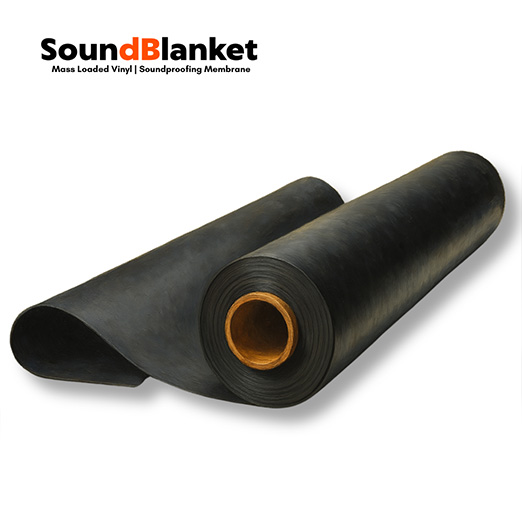
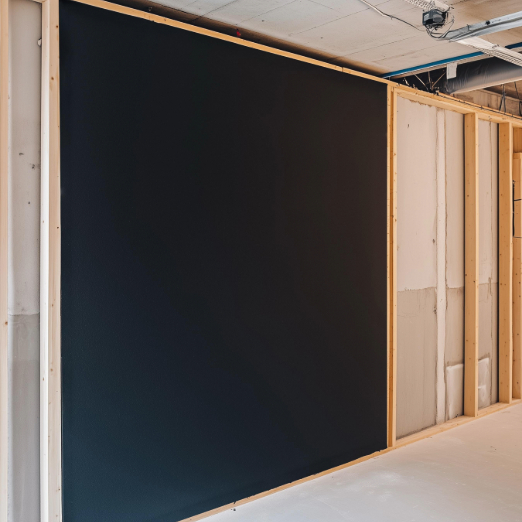
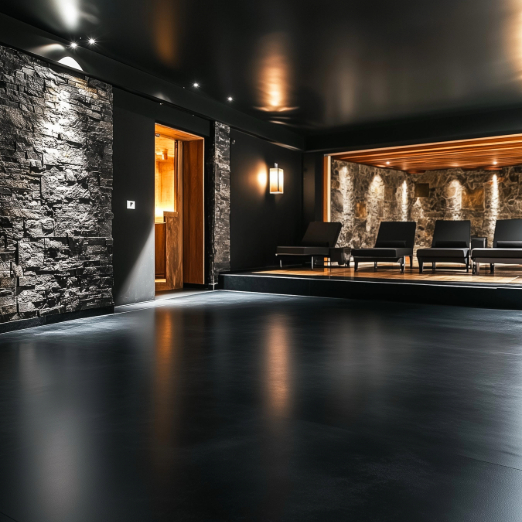
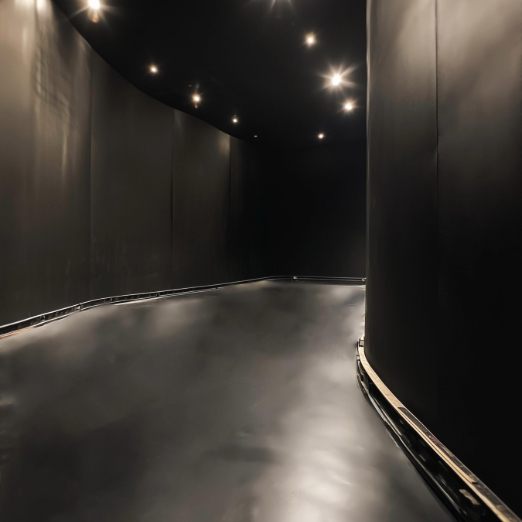
SoundBlanket® is a high-density mass-loaded vinyl (MLV) noise barrier designed for serious soundproofing of walls, ceilings, and floors. It is produced by MMTPL in 2.5 mm, 4 mm, 6 mm and other project-specific thicknesses.
Roll Size:
Key Solution
Provides reliable sound isolation for low to high frequencies, forming the dense barrier layer in multi-layer wall, floor and ceiling assemblies.
Building Structures
Ideal for isolating sound between floors, walls and ceilings in high-rise residential buildings, commercial offices and hotels.
Partitions & Interiors
Enhances soundproofing in wooden, gypsum and metal partitions commonly used in cineplexes, nightclubs, banquet halls, auditoriums, home theatres, recording studios and co-working spaces.
Combination Insulation
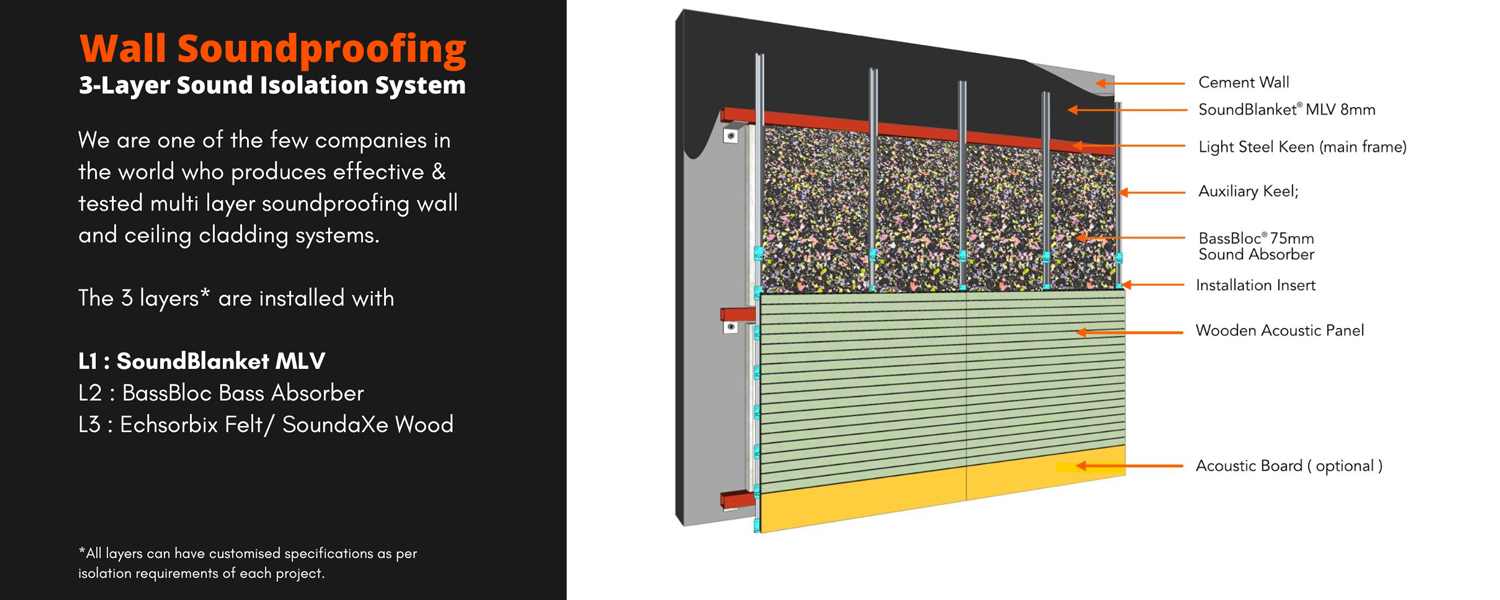
Elevates sound insulation performance when combined with rock wool, glass wool, polyester fibre and acoustic foams, delivering higher STC values in composite systems.
Our specification sheet provides detailed information on available thicknesses, dimensions, and performance attributes, helping you make informed decisions for walls, floors, and ceilings across residential, commercial, and industrial spaces.
Sound Transmission Class by Thickness
| Thickness | STC | Surface weight | Typical use |
|---|---|---|---|
| 2.5 mm | STC 30 | 5.25 kg/m² | Residential and small office partitions |
| 4 mm | STC 34 | 8.4 kg/m² | Hotels, home theatres, commercial interiors |
| 6 mm | On request | 12.6 kg/m² | Industrial enclosures and high-isolation builds |
SoundBlanket® Technical Data
| Thickness | 2.5 mm (also 4 mm, 6 mm and project-specific) |
|---|---|
| Material density | 2100 kg/m³ |
| Surface weight | 5.25 kg/m² (approx. 1.08 lb/ft²) |
| Sheet sizes | 8 × 4 ft, 16 × 4 ft, 32 × 4 ft |
| Coverage and weight | 8 × 4 ft covers 32 sq ft at 22 kg. 16 × 4 ft covers 64 sq ft at 35 kg. |
| Sound Transmission Class | STC 30 at 2.5 mm, STC 34 at 4 mm (ASTM E90) |
| Fire classification | Class A (ASTM E84) |
| Tensile strength | > 30 N/50 mm (NT-67) |
| Elongation at break | > 500% (NT-67) |
| Tear strength (nail) | 153–235 N/50 mm (EN 12310-1) |
| Cold flexibility | To −20 °C (EN 1109) |
| Water vapour resistance | µ ≥ 1806 (UNE-EN 1931 Method B) |
| Water absorption, 24 h at 23 °C | 0.003% (ISO 62 Method 1) |
| Shore hardness A | 30 ±10 (NT 74) |
| Composition | Polymeric resin with inert mineral filler. Lead-free, non-toxic. |
| Packing | Rolled, 120 × 30 × 30 cm carton |
| Shelf life | Over 35 years when stored away from direct heat and sunlight |
| Test standards | ASTM E90 and ASTM C423 (acoustic), ASTM E84 (surface burning), ISO 354 |
| Manufactured in | India, by Mahabir Multi Tech Private Limited |
Datasheets by Thickness
SoundBlanket® 2.5 mm
Thin, lightweight barrier for residential or small office partitions.
Download SpecsSoundBlanket® 4 mm
Balanced performance for hotels, home theatres, and commercial spaces.
Download SpecsGET EXPERT ADVICE
Need Help Choosing SoundBlanket® Mass Loaded Vinyl?
Tell us the space, the area you are covering and the finish you want. Our team will confirm specification, pricing and lead time for your project.
SoundBlanket Mass Loaded Vinyl: FAQ
What is SoundBlanket® Mass Loaded Vinyl (MLV)?
SoundBlanket® MLV is a high-density flexible noise barrier made from polymer-based compounds with added minerals for mass and durability. It blocks airborne sound transmission through walls, ceilings and floors while maintaining a slim profile.
What are the main applications of SoundBlanket® MLV?
It is used in homes, studios, offices, hotels, auditoriums, cinemas, machine rooms and industrial enclosures. Typical uses include stud walls, partitions, under-floor layers, ceiling drops, and composite wall systems with insulation.
How is SoundBlanket® installed?
SoundBlanket® MLV can be mechanically fastened, sandwiched between boards, or adhered using Turbo® SR Adhesive. The joints are overlapped or sealed with acoustic tape to maintain an airtight barrier. Always ensure continuous coverage for best results.
What thickness should I choose – 2.5 mm, 4 mm or 6 mm?
• 2.5 mm – lightweight option for residential or small office partitions.
• 4 mm – balanced choice for professional projects such as hotels and home theatres.
• 6 mm – heavy-duty isolation for industrial or high-STC applications.
Thicker membranes provide higher sound-blocking performance due to increased mass.
Can SoundBlanket® be used with rockwool or glasswool?
Yes. SoundBlanket® is often paired with Rockwool, Glasswool, or Polyester Fibre insulation to create a complete acoustic system, combining absorption (from insulation) and isolation (from MLV).
What certifications does SoundBlanket® MLV have?
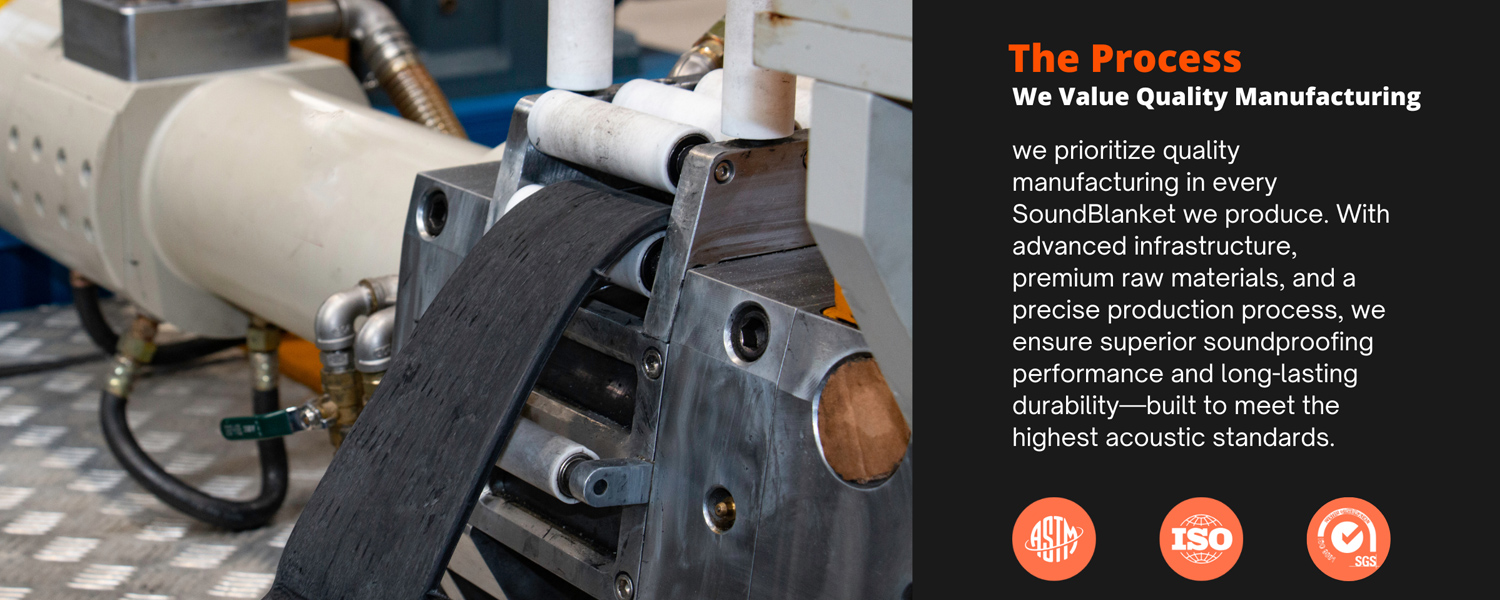
It is tested as per ASTM C423, ASTM E90 and ASTM E84 (Class A Fire Rating). The product also complies with ISO 354 and STC testing standards to ensure proven sound-transmission loss values.
Can SoundBlanket® be customised?
Yes. MMT Acoustix provides customised roll lengths, widths and densities for large projects. Private-label and OEM production options are also available upon request.
What is SoundBlanket® made of?
It is composed of polymeric resin compounds filled with inert mineral materials to increase mass density (approx. 2100 kg/m³). The formulation is lead-free, non-toxic and safe for indoor environments.
What are the delivery times and availability?
Standard thicknesses (2.5 mm / 4 mm / 6 mm) are kept in stock at MMT Acoustix manufacturing units in India. Typical dispatch time is 2–5 working days for national orders and 7–10 days for export shipments.
How is SoundBlanket® different from acoustic foam?
Acoustic foam absorbs echo and reverberation inside a room, while SoundBlanket® MLV blocks noise transfer between rooms. For best results, both materials can be combined – foam for absorption and MLV for isolation.
What STC rating does SoundBlanket® MLV achieve?
SoundBlanket® MLV is rated STC 30 at 2.5 mm and STC 34 at 4 mm, tested to ASTM E90. STC for the 6 mm grade is available on request. These are values for the membrane itself. The STC of a finished wall depends on the whole assembly, including studs, boards, cavity insulation and how well joints and perimeters are sealed.