
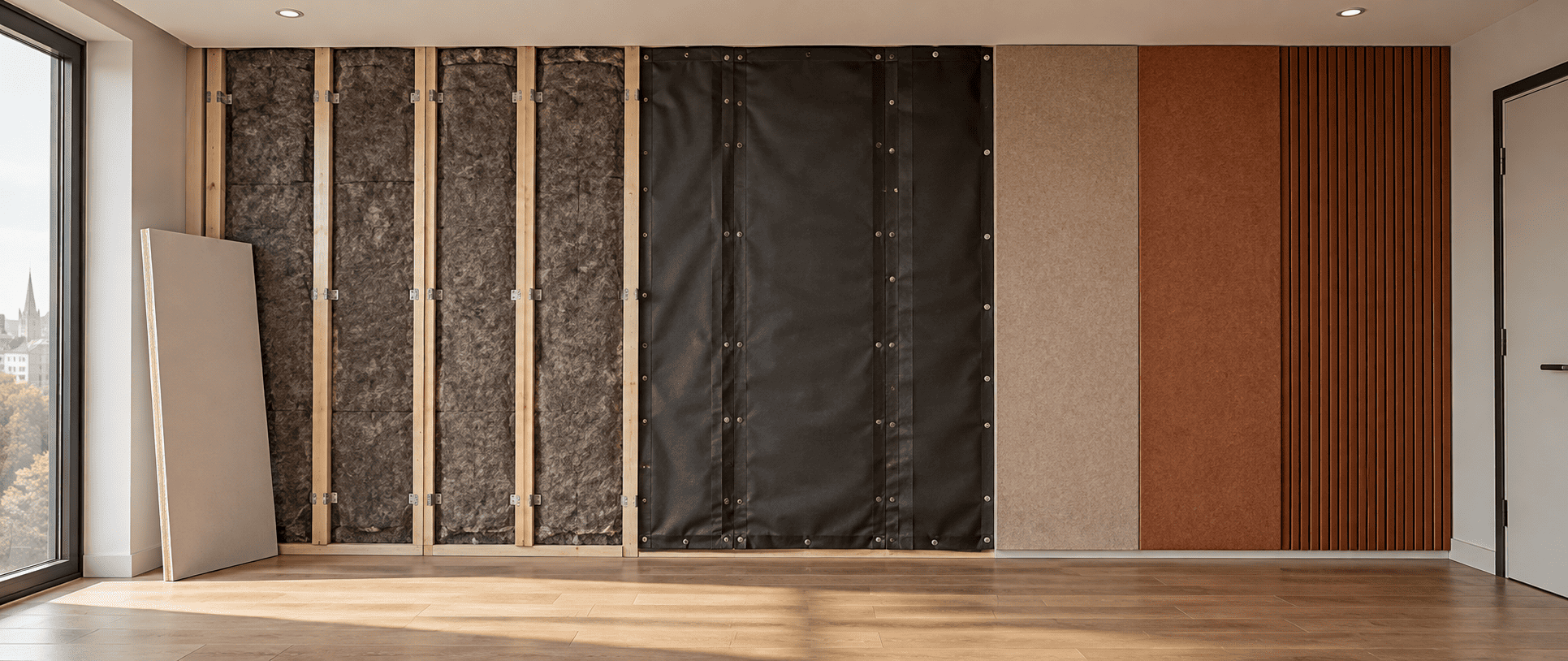
Apartment soundproofing
How to Soundproof a Room from Noisy Neighbors: A Complete Guide
A shared wall can be brought up to hotel grade privacy, but only if the gaps around it are closed with the same care as the wall itself.
A flat owner in Mumbai sent us a voice note recorded from her own bed. Through a brick wall plastered on both faces, the neighbour's television was clear enough to follow the dialogue. Two contractors had told her the wall was the problem and nothing short of a second wall would help. It did need mass. It also had four unsealed electrical boxes, a hollow door onto a common corridor and a window that did not close onto its gasket, and those were doing more work than anyone had accounted for.
This is the pattern in dense housing. Single leaf partitions go up between units because they carry load and meet fire requirements, not because anyone tested them for speech privacy. Services are then cut into both faces of the same wall, often back to back, leaving a partition with small direct holes in it. Any plan that treats only the wall surface will underperform, and the owner concludes that soundproofing does not work.
Which path is the noise actually taking?
Spend an evening identifying the route before spending anything on material. Stand against the shared wall and listen, then move to the door, then the window, then sit on the floor. Noise arriving through the wall is muffled and even. Noise arriving through a gap is sharper and gets louder as you put your ear near the opening. Thumps you feel through the slab are structure-borne and will not respond to anything hung on a wall.
What you learn in that hour decides the order of work. If speech is intelligible, there is an air path somewhere and mass is not the first purchase. If speech is already a mumble and only the bass line comes through, the wall is doing its job and the remaining work is damping, not blocking.
How much mass does a party wall actually need?
Blocking airborne noise is a question of dense, limp, continuous mass. SoundBlanket MLV provides it in a few millimetres rather than a few inches, which is why it is the standard retrofit choice in flats where floor area cannot be given away. At 2.5 mm it is rated STC 30, for light control where the complaint is occasional. At 4 mm it is STC 34, the grade we specify for typical apartments and shared walls. At 6 mm and above, test report on request, for genuinely hostile environments. It comes in 32 x 4 ft rolls, 10 m x 1.2 m, so a party wall is covered in continuous drops rather than patches, and it is tested to ASTM Class A for fire compliance.
MLV is mounted behind drywall or gypsum board rather than left exposed. It is a barrier, not a finish, and it has to be captured and sealed at every edge to work as one continuous membrane.
-
Seal the services first
Open every socket and switch box on the shared wall, fill the void behind it and seal the penetration. Back to back boxes are the commonest defect we find, and added mass does not compensate for them.
-
Fix the MLV as a continuous membrane
Run the drops floor to soffit, overlap and tape the joints, and carry the membrane past the corners rather than stopping at them. A cut for a shelf bracket is a leak.
-
Damp the cavity
Place BassBloc within the assembly before the board goes on, so the low frequency energy is absorbed inside the construction rather than transmitted through it.
-
Board, seal and only then finish
Gypsum goes over the membrane, with an acoustic sealant bead at the floor, the ceiling and both returns. The room face panels come last, once the assembly is airtight.
Built in this order, the layered assembly reaches a composite STC 50 and above, which is the level at which normal speech next door stops being intelligible in your room.
Why the low rumble survives everything you add
Clients often report that the treatment removed the voices and left the thump. That is expected. Low frequency energy from a subwoofer, a home theatre or footfall is long wavelength and travels through structure, flanking the barrier by way of the slab and the columns rather than the wall surface.
BassBloc is the answer to that part, installed inside walls or ceilings rather than on them. It is rated NRC 0.85, supplied in 20 mm and 40 mm, and its job is to stop structure-borne transfer and reduce rumble from subwoofers and footfall impact. On a shared wall carrying a neighbour's television, 20 mm in the cavity alongside 4 mm MLV is the combination we specify most often.
Mass and sealing are not alternatives to each other. A perfectly sealed lightweight wall still passes bass, and a heavy wall with an open socket box still passes speech. Both have to be right before the assembly performs to its rating.
Where a good wall still loses
Openings decide the outcome. On the door, EPDM perimeter seals close the head and jamb gaps and a bottom sweep closes the threshold. If the leaf is hollow core, door soundproofing tiles built from a BassBloc core with an Echsorbix felt face convert it into a dense acoustic barrier.
On the window, soundproof curtains at STC 30 block up to 80 per cent of external noise and add light control and privacy, and they are the practical option where the glazing cannot be replaced. Where it can, double glazing or properly specified window seals give more. In multi storey blocks, MLV under the floor finish and BassBloc above the false ceiling deal with the neighbours above and below, and a thick rug on a bare tiled floor removes a surprising amount of impact noise for very little money.
Why the room still sounds hard once the wall is done
Blocking changes what arrives. It does not change how the room behaves once sound is inside it, and a bedroom with tile, glass and a bare treated wall will still ring. Surface panels fix that, and the coverage needed in a home is modest.
Echsorbix PET felt panels run NRC 0.30 at 9 mm to 0.60 at 24 mm and come in solid colours or grooved designs, which is why they end up on most residential jobs. Fabric wrapped panels at NRC 0.90 with a 50 mm rockwool core give considerably more absorption and suit living areas where a softer finish is wanted. Covering 20 to 30 per cent of the wall area is sufficient in a home. More than that and the room starts to feel airless.
What the Mumbai flat needed
On that apartment bedroom, the shared wall was rebuilt with 4 mm MLV at STC 34 behind gypsum board, BassBloc at 20 mm and NRC 0.85 in the cavity, and Echsorbix felt panels at NRC 0.30 to 0.60 by thickness as the finish. The socket boxes were sealed and the corridor door was gasketed. Audible neighbour noise dropped by roughly 15 to 18 dB. The television is still on next door. It is no longer a conversation you can follow.
What to do first, including in a rented flat
If you own the flat, seal the service penetrations and the door this week, then plan the wall build up in one go rather than in stages, because opening a wall twice costs more than doing it once. If you rent and cannot open anything, the reversible options are still worth doing. Move a full bookshelf against the shared wall, since mass helps regardless of what supplies it. Hang heavy curtains or wall textiles for temporary echo reduction. Seal electrical outlets and wall penetrations with acoustic putty pads, which come out cleanly at the end of a tenancy. To quantify the permanent work, send us the wall length and height, the floor level, and a note on whether the noise is speech or bass.
Products used in this article
Specifications and technical data on each product page. Smaller quantities ship from our online store.
- SoundBlanket Mass Loaded Vinyl STC 30 at 2.5 mm, STC 34 at 4 mm, 32 x 4 ft rolls
- BassBloc Sound Absorber NRC 0.85 to ASTM C423, 20 mm and 40 mm
- Echsorbix PET Felt Panels NRC 0.30 at 9 mm to 0.60 at 24 mm
- Fabric Wrapped Acoustic Panels NRC 0.90, 50 mm rockwool core
- SoundBlanket Soundproof Curtains 4500 GSM, STC 30, NRC 0.20
- EPDM Perimeter Seals and Door Sweeps Self-adhesive, closes the door gap
Visit Online Store opens mmtacoustixonline.com in a new tab. For project quantities, BOQ support or export orders, use the quote form.