
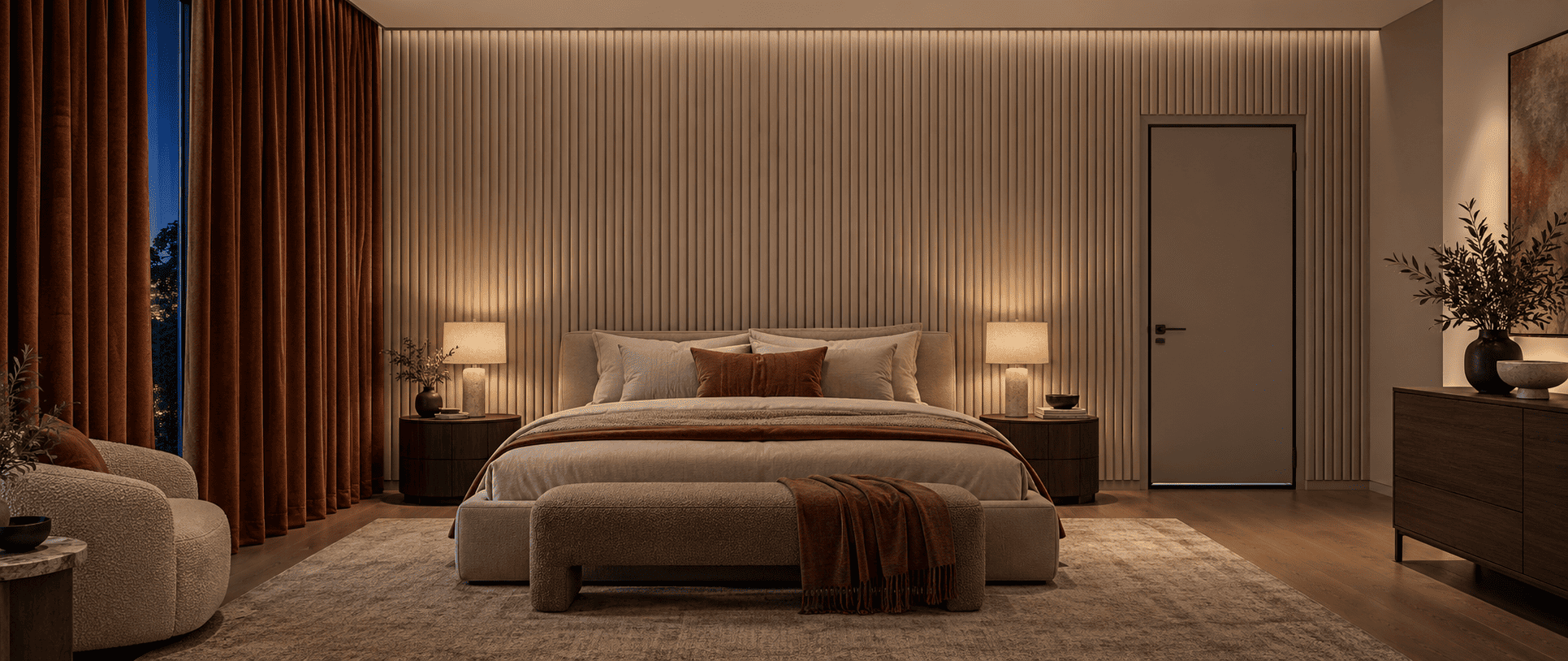
Residential acoustics
How to Soundproof a Bedroom: Curtains, Door Seals & Wall Solutions
A bedroom goes quiet when the leaks are closed and mass is added in the right order, not when more soft material is hung on the walls.
The complaint never arrives as a measurement. It arrives as a description. The bus that pulls away below the window at six in the morning. The lift motor in the shaft behind the headboard. The television next door that goes off at midnight, and the twenty minutes of lying awake afterwards. A bedroom we were asked to look at in Gurgaon faced a main road along its long side, and the owner had already spent money twice, once on heavier curtains and once on a false ceiling. Neither touched the problem, because neither had been aimed at the path the sound was using.
Bedrooms are unforgiving in a way offices are not. At two in the morning the background has fallen away and you are asleep, so a noise a few decibels above that floor is enough to wake you. One unsealed gap around a door undoes a great deal of expensive wall.
What are you actually hearing at two in the morning?
Spend two nights working out what kind of noise you have, because airborne and structure-borne noise are fixed by different products. Airborne noise is speech, traffic, a television, a horn. It travels through air, finds gaps, and is stopped by dense continuous mass. Structure-borne noise is footfall from the floor above, a lift, a pump, the thud of a subwoofer through a shared slab, and mass alone does very little to it.
- Voices and traffic that get clearer when you open the door: an airborne path through the door or window, not the wall.
- Sound that fades when you press your ear to the wall: the wall is not the weak point, look at the openings.
- A dull thump you feel as much as hear: structure-borne, needing damping inside the assembly rather than a surface panel.
- A ring in the room itself, worse when it is bare: reverberation, a comfort issue rather than an isolation one.
Most urban bedrooms turn out to be a mixture, and the largest contributor is usually the window wall, which is the part people least want to change.
Why mass goes on before anything decorative
The first layer is the one nobody sees. SoundBlanket MLV is a limp, high density membrane that goes behind the wall finish and blocks airborne sound, rated STC 30 at 2.5 mm and STC 34 at 4 mm. It ships as 32 x 4 ft rolls, which is 10 m x 1.2 m, so a bedroom wall is covered in two or three drops with sealed overlaps and no joints left open, adding a few millimetres to the room rather than a few inches.
Within the same assembly, BassBloc deals with the part MLV cannot. It damps low frequency vibration and structural transfer, NRC 0.85, supplied in 20 mm and 40 mm, and it is the reason a treated wall stops passing the bass line from a neighbouring flat rather than simply muffling the voices over it.
Only after those two layers does anything visible go on. Acoustic foam at NRC 0.90, in the concave Galaxy profile or Pyramid, suits a client who wants an obvious studio look. Echsorbix PET felt, NRC 0.30 at 9 mm rising to NRC 0.60 at 24 mm, is what we use in most bedrooms, because it reads as an interior material rather than equipment.
| Layer | Rating | What it does |
|---|---|---|
| SoundBlanket MLV, 2.5 mm or 4 mm | STC 30 at 2.5 mm, STC 34 at 4 mm | Blocks airborne noise, street traffic and television from the next room |
| BassBloc, 20 mm or 40 mm | NRC 0.85 to ASTM C423, 20 mm and 40 mm | Damps low frequency vibration and structure-borne transfer |
| Acoustic foam or Echsorbix felt on the face | Foam NRC 0.90, felt NRC 0.30 at 9 mm to 0.60 at 24 mm | Controls echo inside the room and finishes the wall |
For a standard 12 x 10 ft bedroom, put MLV and BassBloc on the shared or noisy walls only, and cover 30 to 50 per cent of the wall surface with foam or felt. Beyond that you are paying to make the room dead rather than quiet.
Absorption and isolation are not the same purchase. Panels on a bare wall make the room sound calmer and change what your neighbour hears by almost nothing. If the goal is to stop noise arriving, the money belongs in mass and seals first.
How much of it is coming under the door?
Bedroom doors are usually hollow core, hung with a gap at the threshold, and they can leak up to 30 per cent of the noise reaching the room. Sound follows air, and a strip of daylight under a door does not attenuate speech at all.
Two products close it. EPDM perimeter seals are a flexible self-adhesive gasket for the head and both jambs, and a bottom door seal in metal and vinyl handles the threshold, adding up to 3 dB on its own. Fit both before you judge the wall, because an hour of sealing tells you whether the remaining complaint is transmission or leakage.
Once the perimeter is tight, what is left comes through the leaf, and a hollow door has very little mass to offer. Door soundproofing tiles bond a composite to the face, a BassBloc core at NRC 0.85 with an Echsorbix felt finish, giving a system NRC of 0.90 and turning a light leaf into a dense panel.
What a 4500 GSM curtain can and cannot do
On a road facing bedroom the window is usually the weakest element in the envelope, and the one element most clients will not replace. Soundproof curtains are the practical answer there. Ours are a heavy multi layer build at 4500 GSM, rated STC 30 and NRC 0.20, available in six shades, and they block up to 80 per cent of external sound while giving light control and privacy.
Two conditions apply. They must be full length and wall to wall rather than sized to the opening, since a curtain stopping at the reveal leaves the flanking path open. And they do best paired with double glazed windows or window seals, because a curtain treats what comes through the glass, not what whistles around a badly closing casement.
Do the floor and the ceiling need touching?
In an independent house, usually not. In a flat with occupied space above or below, often yes, and it is worth deciding before the walls are closed. SoundBlanket MLV laid under the flooring reduces impact noise carried downward, the footsteps, the chairs, the dropped objects. BassBloc above a false ceiling blocks upstairs footfall and airborne noise coming down. Both are upgrades rather than defaults, and if the neighbour above is quiet and the road is not, that budget belongs on the window wall.
What the Gurgaon bedroom needed
The bedroom that started this article faced a high traffic main road. We installed 4 mm MLV at STC 34 across the exposed walls, added BassBloc at 20 mm with Echsorbix felt panels as the visible finish, fitted EPDM seals to the door and hung full height soundproof curtains across the window wall. Noise reduction was in the region of 15 to 18 dB, the point at which traffic stops being intelligible and becomes background.
What to do first in your own bedroom
Start with the door and the window, because they are cheap to test and they are where most bedrooms lose. Seal the door perimeter and the threshold, sleep two nights, and listen again at the same hour. If the noise is now dull rather than clear, the leaks are closed and any further gain has to come from mass on the wall. If you can still make out words, something is still open, and no panel will cover it. Send us a plan with the shared walls marked, the window size and the floor above, and we will come back with a build up and a quantity, not a catalogue.
Products used in this article
Specifications and technical data on each product page. Smaller quantities ship from our online store.
- SoundBlanket Mass Loaded Vinyl STC 30 at 2.5 mm, STC 34 at 4 mm, 32 x 4 ft rolls
- BassBloc Sound Absorber NRC 0.85 to ASTM C423, 20 mm and 40 mm
- Echsorbix PET Felt Panels NRC 0.30 at 9 mm to 0.60 at 24 mm
- Acoustic Foam, Galaxy and Pyramid NRC 0.90
- SoundBlanket Soundproof Curtains 4500 GSM, STC 30, NRC 0.20
- EPDM Perimeter Seals and Door Sweeps Self-adhesive, bottom seal adds up to 3 dB
Visit Online Store opens mmtacoustixonline.com in a new tab. For project quantities, BOQ support or export orders, use the quote form.