
Doors and openings
Door Seals & Soundproofing Tiles: Block Noise Leaks at the Weakest Point
The cheapest isolation on most projects is sitting in the gap around the door, unclaimed.
A boardroom in Gurugram was handed over with a wall build-up any consultant would sign off. Mass loaded vinyl behind the gypsum, two board layers, mineral wool in the cavity, services boxed and sealed. The client sat down in it and heard the receptionist take a call. Nothing was wrong with the wall. The problem was a 6 mm strip of daylight under a flush door, and a hollow leaf that behaved like a drum skin.
This is the most common failure we are called back to look at, and it is almost never a manufacturing issue. Doors leak 30 to 40 per cent of unwanted noise. Sound follows air, and a door is the only part of a partition designed to move.
How much isolation is a 6 mm gap costing you?
A partition performs at the level of its weakest continuous path, not its average. A gap running the full width of a door head and both jambs is a direct air path between two rooms, and it does not attenuate speech at all. Whatever the wall achieves, the room drops toward the performance of that opening.
You can find the leaks without instruments. Close the door, switch off the lights inside, and have someone stand in the corridor with a torch. Wherever light comes through, sound comes through. Then run a sheet of paper around the perimeter with the door shut. If it slides out anywhere, the seal is not compressing. Most doors on site fail along the lock stile and at the head, because the frame was fixed before the floor finish went down and the leaf now hangs slightly out of square.
Fit the seals before you judge the wall. Sealing a single door is about an hour of work, and it tells you whether the remaining complaint is transmission through the partition or leakage through the opening.
Which seal goes where on the leaf?
A door has two kinds of gap and therefore needs two products. The three sides that meet a frame need a compressible gasket. The bottom, which has to clear the floor finish, needs something that drops or sweeps. Our EPDM perimeter seals and door sweeps cover both conditions, and the choice is driven by door type rather than budget.
| Component | Specification | Where it is used |
|---|---|---|
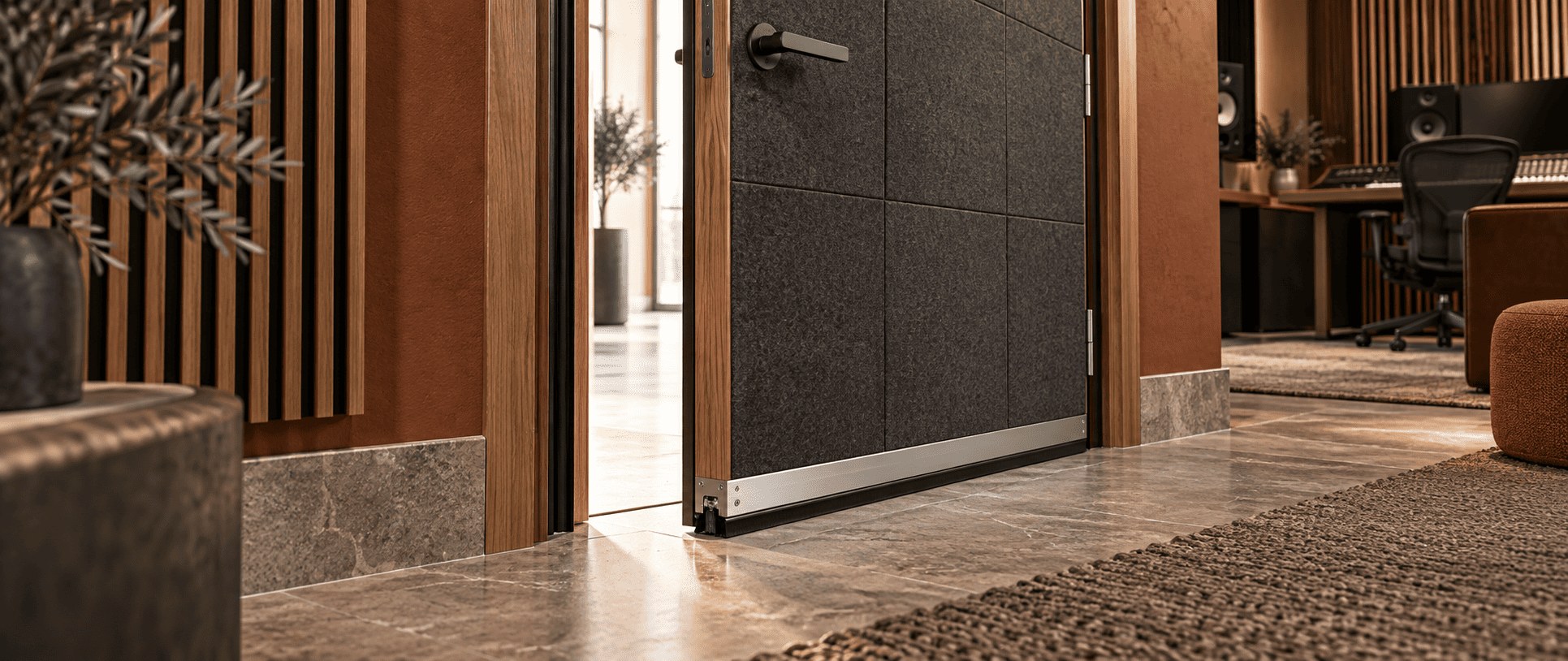
| Bottom door seal, metal and vinyl | STC 3 improvement per sealed door, 36 x 1.5 inches, aluminium base with high-density vinyl sweep | Offices and bedrooms, blocks air and noise leakage beneath the leaf |
| Self-adhesive bottom seal, vinyl | Peel and stick, no drilling | Residential and retrofit work where the leaf cannot be taken off its hinges |
| Perimeter door tape, EPDM self-adhesive | 18 ft roll, 6 x 9 mm thickness | Head and both jambs of wooden or metal doors, closes side and top gaps |
Fitted together, perimeter tape and a bottom seal give up to 8 to 10 dB of noise reduction on a standard door, for a fraction of what re-doing the partition would cost.
Why a sealed door can still sound thin
Sealing removes the air path. It does not add mass, and a hollow core flush door has very little of it. Once the perimeter is tight, the remaining transmission is through the leaf, heard as a dull, muffled version of the conversation next door rather than a clear one. In a meeting room or a studio that is progress but not enough.
This is where door soundproofing tiles earn their place. They are a faced panel bonded to the door surface, adding mass at the leaf and damping the resonance that makes a light door ring. The core is BassBloc at 20 mm, NRC 0.85, which handles the low-frequency vibration a thin leaf passes most easily. The visible face is Echsorbix PET felt at 9 mm, NRC 0.30, which takes the mid and high frequencies on the room side and gives the door a finish that belongs in a corporate interior.
Used on both faces of a light door, the combination converts an ordinary leaf into a rated acoustic barrier. Tiles come pre-cut for standard 36 x 80 inch doors, so there is no site cutting on most jobs, and they are available in ColourMute shades to match or contrast with the partition system.
How the tiles go on without ruining the door
-
Check the leaf and the hinges first
Tiles add weight. On a hollow door with two light butt hinges, add a third or upgrade to ball-bearing hinges before bonding anything, or the door will drop and reopen the gap you just closed.
-
Seal the perimeter before facing
Fit the EPDM tape to the frame rebate on the head and both jambs, then set the bottom seal so the sweep just brushes the finished floor. Sealing first means you know the leaf closes correctly before the surface thickness changes.
-
Set out the tiles dry
Lay the tiles on the leaf without adhesive and mark the edges, keeping the tile line clear of the lock, the closer arm and the vision panel. Leave the hinge stile edge slightly short so the tile cannot foul the frame as the door swings.
-
Bond with SR adhesive or fix mechanically
SR adhesive is the normal method and keeps the face clean. Mechanical fasteners suit fire rated doors, or a client who wants the tiles removable at the end of a lease.
-
Close the door and re-test
Repeat the torch and paper test. Tile thickness changes how the door meets the stop, so the seals usually need one small adjustment after facing. Skipping this is how a properly specified door ends up leaking again.
What a New Delhi home office needed
A private home office in New Delhi, facing a busy street, had to hold video meetings all day. The wall and glazing were already in place and could not be opened up, so we fitted EPDM perimeter seals and a bottom door seal to the entrance door, then faced the leaf with Echsorbix-faced BassBloc door tiles. Noise intrusion fell by roughly 12 dB. No partition was touched.
How the door fits into the rest of the system
Doors are one layer in a sequence, and they are the layer most often left out of the specification. In a full build-up, SoundBlanket MLV at STC 30 to 34 sits behind the wall finish and does the blocking. BassBloc at NRC 0.85 to 0.95 sits within the assembly to stop vibration transfer. Acoustic panels or felt finishes go on the room face for echo control. A sealed and faced door brings the opening up toward that build-up instead of dragging it down. The reverse is also worth saying plainly to clients who want to stage the work: treating the door first, on its own, gives a measurable result on day one, while treating the wall first with the door still open at the perimeter usually does not.
What to do first on your own door
Start with the torch test on every door in the complaint area and write down which ones fail. Fit perimeter tape and a bottom seal to those doors before ordering anything else, then listen again in the same conditions and at the same time of day. If the residual noise is now dull rather than intelligible, the leak is closed and any further gain has to come from mass, which means door tiles. If speech is still intelligible through the closed door, the seal is not compressing somewhere and the fix is a hinge or frame adjustment, not more material. Bring the door into the BOQ at design stage rather than at snagging, and send us the door schedule with leaf sizes and hinge details so seal lengths and tile cuts arrive ready to fit.
Products used in this article
Specifications and technical data on each product page. Smaller quantities ship from our online store.
- EPDM Perimeter Seals and Door Sweeps 18 ft roll, 6 x 9 mm, self-adhesive
- Bottom Door Seal, Metal and Vinyl 36 x 1.5 inches, STC 3 improvement per door
- BassBloc Sound Absorber 20 mm, NRC 0.85, door tile core
- Echsorbix PET Felt Panels NRC 0.30 at 9 mm to 0.60 at 24 mm
- SoundBlanket Mass Loaded Vinyl STC 30 at 2.5 mm, STC 34 at 4 mm
Visit Online Store opens mmtacoustixonline.com in a new tab. For project quantities, BOQ support or export orders, use the quote form.