
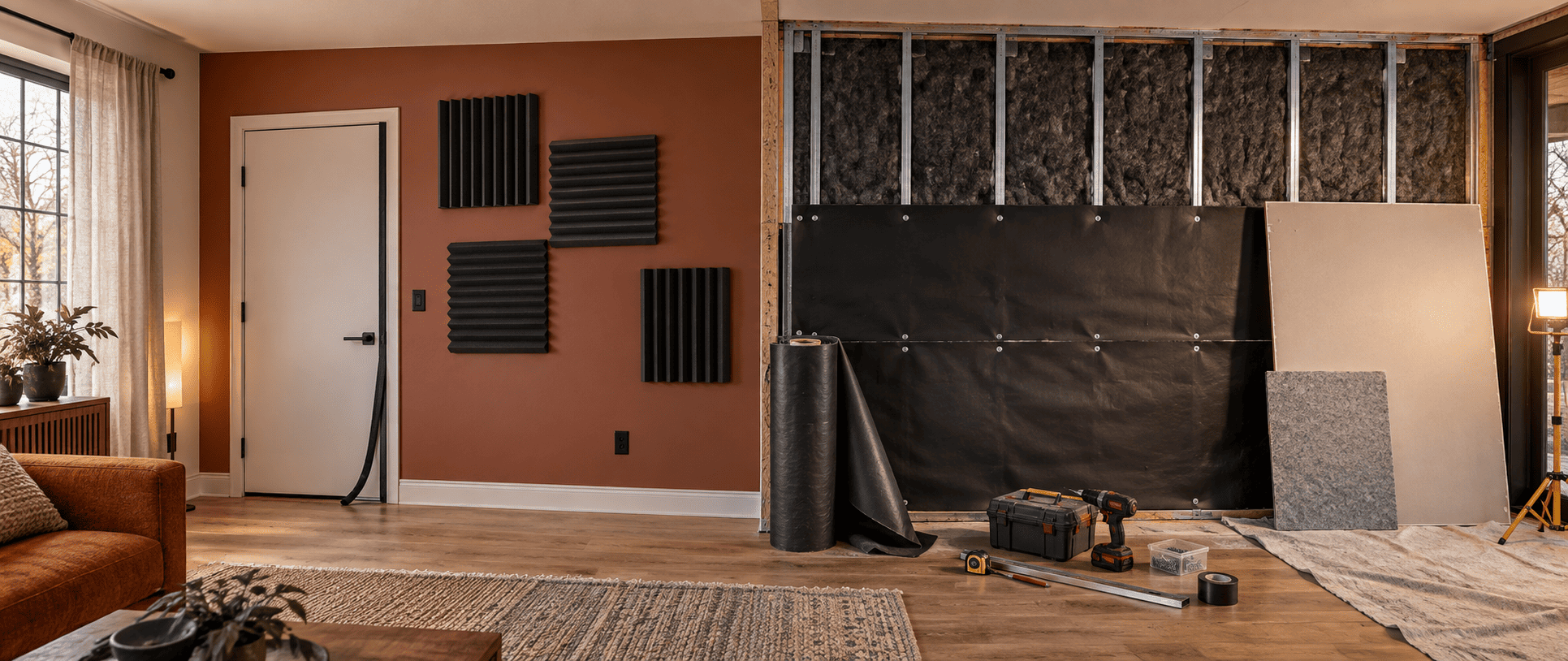
Choosing an approach
DIY vs Professional Soundproofing: Which One Should You Choose?
An honest account of what a weekend of work can achieve, where it stops, and what has to be opened up before the noise genuinely goes away.
A customer in Pune sent us a photograph of his home office with forty foam tiles glued across one wall, and a message that read, more or less, "it sounds nicer in here but I can still hear the neighbours". He was not wrong about either half of that. The foam had done exactly what foam does, and nothing at all about the problem he bought it for.
This is the most expensive mistake in the subject, and it is a vocabulary failure rather than a knowledge one. Two separate problems share the word "soundproofing", and most disappointing outcomes come from buying a product for one and expecting results from the other.
Two different problems share one word
The first is absorption. Sound made inside a room bounces around it, so speech smears, recordings pick up the room, and the space feels harsh. You fix that with porous material on the surfaces, and the figure is NRC.
The second is isolation. Sound made elsewhere, a neighbour, a road, a plant room, passes through walls, floors and openings into your room. You fix that with mass, airtightness and decoupling, and the figure is STC.
Porous material has almost no mass, so it cannot block. Dense material has no porosity, so it cannot absorb. Plenty of rooms have both problems, which is why a finished job usually contains layers of each.
The weekend version, and what it is worth
DIY soundproofing is genuinely useful for small projects and minor noise. It is budget-friendly, needs almost no tools, and in a rented flat it is often the only option that does not breach the lease. Four things are worth doing, in this order of return.
- Soundproof curtains: acoustic curtains rated STC 30 block up to 80% of street noise, and being a hung item they are rental-friendly for bedrooms and living rooms.
- Door seals and sweeps: EPDM perimeter seals with bottom sweeps block 30 to 40% of door leakage, the cheapest measurable improvement available to anyone.
- Acoustic foam panels: acoustic foam at NRC 0.90, in Galaxy, Pyramid and Curve profiles, improves internal clarity in home studios and gaming rooms. That is absorption, not isolation.
- Bookshelves and rugs: dense furniture against a shared wall and thick carpet on a hard floor add passive mass where you were putting something anyway.
Where does that land you? Realistically, 5 to 10 dB of relief on the sources it can touch. That is minor but not trivial: it is the difference between a television next door being intrusive and being background. For echo control in a small room it is the whole job.
A door is the weakest element in nearly every wall, because the gap around a standard leaf is an open air path. Sealing it first costs least and changes most, whether or not the rest of the project is DIY.
Where the weekend version runs out
The limits are predictable and arrive in the same three ways. Surface-applied products cannot block high-decibel sources. Heavy road traffic, a loud neighbour, a generator: these need mass in the wall, and nothing hung on its face provides that. Second, DIY measures carry no certified STC performance, so a specification, a residential code or a landlord's acoustic clause will not be satisfied however well they work in practice. Third, nothing in the DIY list addresses low-frequency vibration. Bass from a music system, machinery hum, a lift motor: those travel through the structure itself.
If you have tried the weekend version and the problem is still there, that is not a sign you did it badly. It is a sign you have one of those three problems.
What changes when the wall is opened up
Professional soundproofing is not better materials. It is access. Once the drywall comes off you can put mass inside the assembly, break the rigid path between the two sides and seal the perimeter properly, and those three moves are where the serious numbers come from.
-
Add mass inside the wall
SoundBlanket MLV, STC 30 at 2.5 mm and STC 34 at 4 mm, installed behind the drywall or ceiling board to block airborne noise where it crosses the assembly.
-
Damp the low frequencies
BassBloc, NRC 0.85 to 0.95, inside the cavity to control vibration from bass, music systems and heavy machinery that mass alone does not settle.
-
Decouple the structure
Floating floors and double-stud walls remove the rigid connection between the two leaves of a partition. This is what takes an assembly to STC 55+ and meets hotel and residential codes.
-
Finish with the right absorption
Echsorbix PET felt panels, NRC 0.30 at 9 mm to 0.60 at 24 mm, for offices, gyms and residences, or fabric wrapped panels and wooden slats where the room needs a finished architectural surface.
The reason to hire this out is rarely the materials, which anyone can buy. It is that the sequence is unforgiving. A mass layer with an unsealed seam, or a resilient channel screwed through into the stud behind it, loses most of the performance you paid for, and the mistake is invisible once the board goes on.
How the two approaches compare on paper
| Criteria | DIY soundproofing | Professional soundproofing |
|---|---|---|
| Cost | Low to moderate | Higher upfront, long-term value |
| Noise reduction | 5 to 10 dB, minor relief | 15 to 30+ dB, certified STC 50+ |
| Skill required | Basic DIY skills | Installed by certified acoustic teams |
| Materials used | Curtains, foam, seals | MLV, BassBloc, NRC panels, floating floors |
| Best for | Rentals, light noise issues | Hotels, offices, studios, apartments |
The cases needing the professional column are consistent: home theatres and recording studios, which need STC 55+ and NRC 0.90+ together; hotels and apartments working to code-compliant partitions; industrial and mechanical rooms with low-frequency vibration; and confidential spaces such as boardrooms and government offices, where the requirement is speech privacy rather than comfort.
What a Mumbai apartment actually took
A flat in Mumbai had two overlapping sources, a neighbour's television through the party wall and traffic through the street elevation. The owner had already tried curtains and foam panels. The improvement was around 5 dB, and the television was still audible in the bedroom.
Opening the wall changed the picture. SoundBlanket MLV at 4 mm, STC 34, went in behind the drywall as the mass layer. BassBloc at 20 mm, NRC 0.85, went into the cavity for vibration damping. The room was finished with felt acoustic panels, NRC 0.30 at 9 mm to 0.60 at 24 mm, to settle the internal acoustic at the same time. The partition reached STC 52+, which in that flat meant the neighbour's television stopped existing as far as the bedroom was concerned.
The DIY attempt was not wasted work. It correctly identified that the problem was isolation rather than absorption, and the curtains still earn their place on the street-facing window.
Where to start this week
Before spending anything, spend ten minutes diagnosing. Ask whether the noise that bothers you is made inside the room or outside it. If inside, you want absorption and the DIY route will probably satisfy you. If outside, ask whether you hear words and detail, which means airborne transfer that mass will address, or only a thud and a hum, which means structure-borne transfer needing decoupling.
Then seal the door, whatever the answer was. It is cheap, reversible, and it removes the variable that would confuse every later judgement. If the noise still bothers you, you have learned something specific and you are ready for a real conversation about the wall.
A hybrid path is perfectly legitimate: start with the DIY layer for mild noise and upgrade where the problem proves serious. Send us the room dimensions, the shared boundary and what you are hearing, and we will tell you which column of that table you belong in.
Products used in this article
Specifications and technical data on each product page. Smaller quantities ship from our online store.
- SoundBlanket Soundproof Curtains 4500 GSM, STC 30, NRC 0.20
- EPDM Perimeter Seals and Door Sweeps Self-adhesive, closes the door gap
- Acoustic Foam, Galaxy, Pyramid and Curve NRC 0.90, 6 x 3 ft sheets or 1 x 1 ft tiles
- SoundBlanket Mass Loaded Vinyl STC 30 at 2.5 mm, STC 34 at 4 mm
- BassBloc Sound Absorber NRC 0.85 to ASTM C423, 20 mm and 40 mm
- Echsorbix PET Felt Panels NRC 0.30 at 9 mm to 0.60 at 24 mm
Visit Online Store opens mmtacoustixonline.com in a new tab. For project quantities, BOQ support or export orders, use the quote form.