
Materials explained
Acoustic Insulation vs Soundproofing Membranes: What’s the Difference?
One absorbs the sound already in your room, the other stops sound crossing the wall, and knowing which is which saves an expensive rebuild.
The most common call our technical desk takes goes like this. A customer has covered a bedroom wall in acoustic foam, corner to corner, and the neighbour's television is still perfectly audible. They want to know whether they should have bought thicker foam. The honest answer is that thicker foam would have changed nothing, because the material was never going to do that job.
Two families of product are sold under the loose heading of soundproofing, and they behave nothing alike. Acoustic insulation absorbs sound energy inside a room. Soundproofing membranes stop sound passing through a structure. Both are measured, both are certified, and the certificates are not interchangeable. Most failed projects are the right product doing the wrong job.
Why does one wall need two different products?
Sound reaches your ears by two routes. Some of it leaves a source in your room, bounces off the hard surfaces and arrives late, smearing speech and thickening music. That is reverberation, an absorption problem. The rest starts in another room, sets the shared partition vibrating, and the partition re-radiates it into your space like a large flat loudspeaker. That is transmission, a mass and isolation problem.
Absorbent material inside your room cannot help with the second route, because the wall is not reflecting the neighbour's television, it is driving it. Equally, a dense membrane buried in the construction does nothing for your echo, because sound in your room never reaches it.
What does absorption actually do to a room?
Absorbers are porous. Sound pressure forces air through a fibrous or open-cell structure, friction converts a very small amount of that energy to heat, and less comes back into the room. The metric is NRC, the Noise Reduction Coefficient, an average of absorption at four frequencies on a scale where 0 reflects everything and 1 absorbs effectively everything, measured in a reverberation chamber to ASTM C423 or EN ISO 354.
- Mineral wool: high-density at 96 kg/m3, the core of fabric panels and the fill inside wall cavities, never seen.
- Echsorbix PET felt: NRC 0.30 at 9 mm rising to 0.60 at 24 mm, a finish for offices, gyms and nightclubs that takes routine contact.
- Acoustic foam: NRC 0.90, the usual choice for studios and theatres where appearance follows performance.
Thickness is the variable that matters most. Echsorbix PET felt is the clearest illustration: the same material, the same fibre, and the NRC nearly doubles between 9 mm and 24 mm. Low frequencies have long wavelengths and need depth to be caught, which is why a thin decorative panel can look like an acoustic product and do almost nothing for the frequencies that make a room feel loud. Absorption belongs on the room-facing surfaces you can see, in offices for speech clarity, studios for clean playback, and gyms and nightclubs where music would otherwise pile up on itself.
What does a membrane do that no absorber can?
Blocking is about mass, limpness and airtightness. A heavy, floppy layer is hard to set in motion and radiates poorly once moving, so less energy reaches the far side. SoundBlanket mass loaded vinyl is exactly that: a high-density, flexible sheet at 2100 kg/m3 that adds weight to a partition without adding stiffness. The metric is STC, Sound Transmission Class, derived from laboratory transmission loss measured to ASTM E90. It is a dimensionless index, never written with a decibel unit after it.
SoundBlanket is rated STC 30 at 2.5 mm and STC 34 at 4 mm, with custom thicknesses from 1 to 10 mm available and a test report on request at 6 mm and above. It ships in 32 x 4 ft rolls so a wall can be covered with very few joints, carries an ASTM Class A fire rating, and is non-toxic and flexible enough to follow a ceiling profile.
Reading the two spec sheets side by side
| Aspect | Acoustic insulation | Soundproofing membrane |
|---|---|---|
| Purpose | Absorbs sound, reduces echo | Blocks sound, stops transmission |
| Performance metric | NRC, Noise Reduction Coefficient | STC, Sound Transmission Class |
| Material examples | PET felt panels, fabric panels, acoustic foam | SoundBlanket MLV, resilient channels |
| Best for | Internal clarity and reverberation control | Speech privacy and external noise isolation |
| Installation | On room-facing surfaces, visible | Hidden within walls, floors or ceilings |
A useful discipline when reading any datasheet: if the figure is an NRC, ask what thickness it was measured at and whether there was an air gap behind the sample. If it is an STC, ask what the whole partition was. Both numbers describe a tested assembly, not a material on its own.
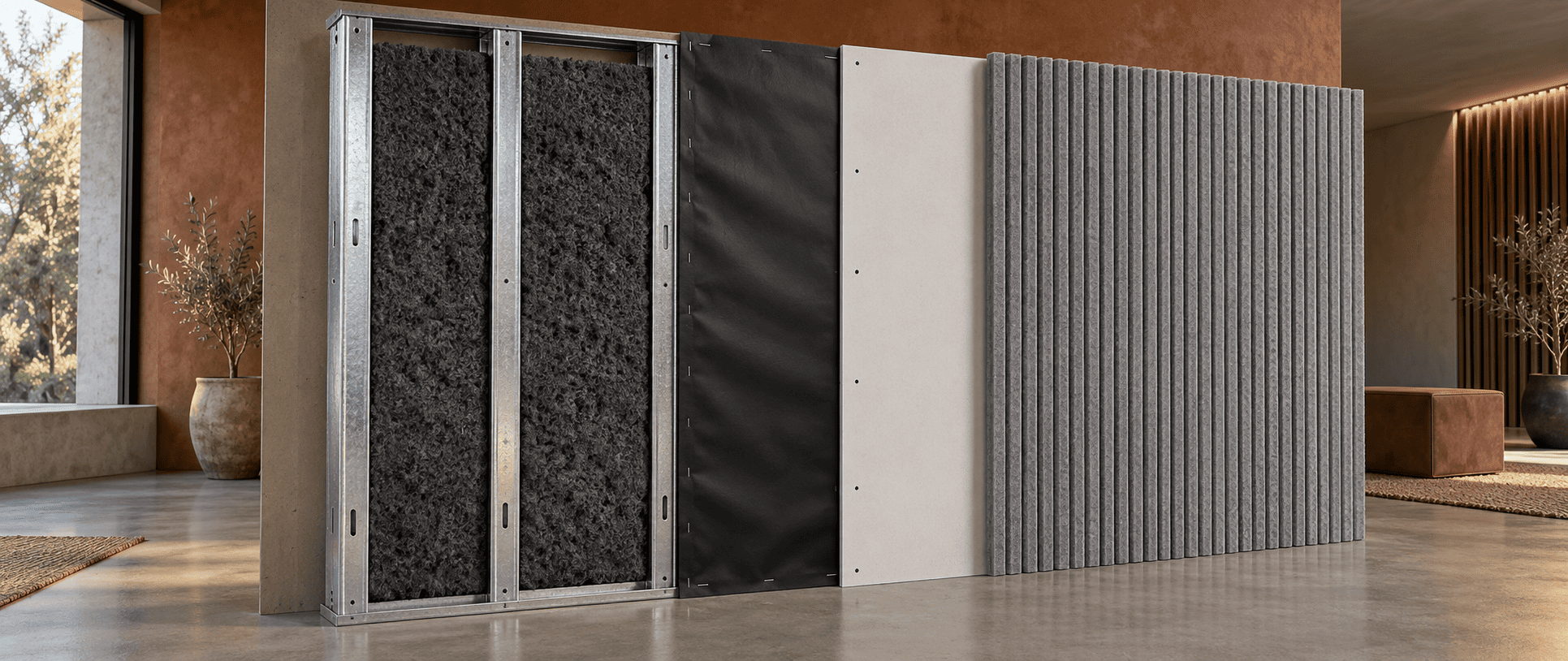
How do the two layers stack in a real wall?
On any serious project both jobs exist at once, and the order is fixed by the construction sequence. Get it wrong and the only remedy is to open the wall again.
-
Frame and fill the cavity
Mineral wool at 96 kg/m3 goes into the stud cavity. Inside a partition it is not there to fix your echo, it damps the air space between the two skins so the cavity does not act as a spring coupling them together.
-
Add the mass layer
SoundBlanket MLV is fixed over the frame or between board layers, at STC 30 for 2.5 mm or STC 34 for 4 mm. Every perimeter, service penetration and roll overlap gets sealed. On a home theatre or a plant-adjacent wall, BassBloc at 20 mm, NRC 0.85, goes in at this stage, while the build-up is still open.
-
Close up and board
The finishing board goes on and the wall is as isolated as it will ever be. Nothing added after this point improves the STC of the partition, which is the fact most retrofit projects discover too late.
-
Treat the room surface
Now the absorption goes on, visible and sized against the room volume. PET felt, acoustic foam or fabric wrapped panels at NRC 0.90, chosen for the absorbed area the room needs and how the space has to look.
For an apartment bedroom facing a busy road that reduces to something simple: MLV at STC 34 behind the wall to block the traffic, Echsorbix PET felt at NRC 0.30 to 0.60 by thickness inside the room to absorb the reflections.
A Mumbai home theatre, built in the right order
A premium home theatre in Mumbai had both faults at once. Sound was leaking into the rest of the apartment, and inside the room dialogue was smeared by reflections off the side walls. The owner had already been sold surface panels, which addressed neither complaint.
The rebuild followed the sequence above. SoundBlanket MLV at 4 mm, STC 34, went behind the walls. BassBloc at 20 mm, NRC 0.85, was added for low-frequency damping, which in a room with a subwoofer is the difference between isolation on paper and isolation the neighbours agree with. Fabric wrapped panels at NRC 0.90 finished the internal acoustics. The result was cinema-grade isolation with clear audio inside, from three ordinary products each doing the job it was designed for.
Where to start before you buy anything
Ask one question first: is the sound that bothers you made in this room, or in another one? If the problem is your own voice coming back at you, if conversation feels tiring or the television needs turning up, that is reverberation and you need absorption on visible surfaces. If the source is one you cannot see, a neighbour, a corridor, a road, that is transmission and no surface treatment will fix it.
If both are true, and in most projects both are true, plan the isolation first because it is buried and irreversible, then size the absorption to the room afterwards. Ask for the test report behind every number you are quoted, and check the thickness it was measured at.
Products used in this article
Specifications and technical data on each product page. Smaller quantities ship from our online store.
- SoundBlanket Mass Loaded Vinyl STC 30 at 2.5 mm, STC 34 at 4 mm
- Echsorbix PET Felt Panels NRC 0.30 at 9 mm to 0.60 at 24 mm
- Acoustic Foam, Galaxy, Pyramid and Curve NRC 0.90, 6 x 3 ft sheets or 1 x 1 ft tiles
- Fabric Wrapped Acoustic Panels NRC 0.90, 50 mm rockwool core
- BassBloc Sound Absorber 20 mm, NRC 0.85, behind the wall finish
Visit Online Store opens mmtacoustixonline.com in a new tab. For project quantities, BOQ support or export orders, use the quote form.