
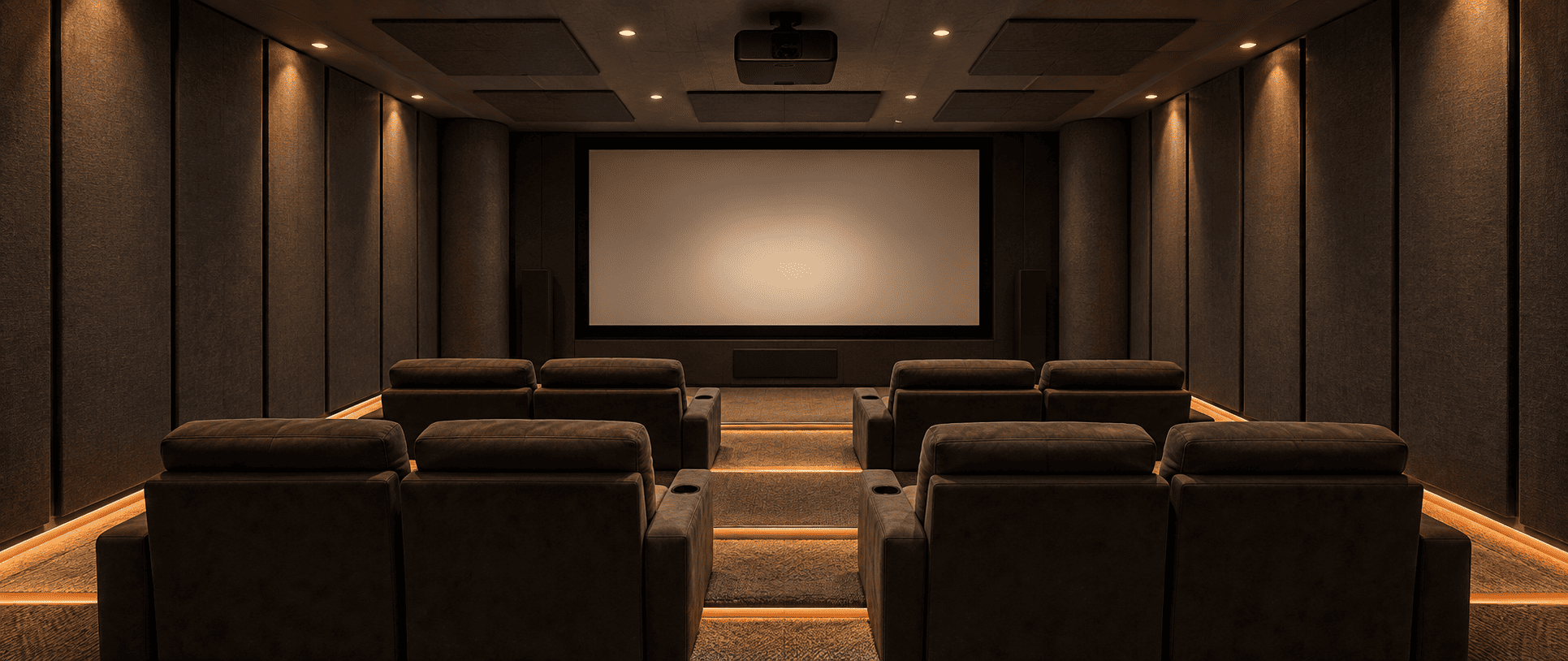
Home theatre and studio
Soundproofing Solutions for US Home Theatres and Studios
Barriers stop the bass reaching the rest of the house, absorption makes the room worth sitting in, and you need both.
The call usually comes about a week after the projector is calibrated. The room looks superb, the seating is in, the subwoofer has been dialled in by an installer who knew what he was doing, and the family has discovered that they can only use it between about four in the afternoon and nine at night. Anything earlier wakes someone; anything later brings a complaint from the bedroom next door or, in a tighter neighbourhood, from across the fence. Nobody budgeted for the walls, because the walls were already there.
Studios reach the same place from the other direction. A vocal take is ruined by a lawnmower two houses away, or a snare sounds like it was recorded in a stairwell. In both rooms the underlying situation is identical: the shell was built to keep weather out, not sound in, and the surfaces inside are hard, parallel and untreated.
Three things the room has to get right
Before choosing products, be clear about which of these three you are buying. They are separate goals and they use separate materials.
- Block noise leakage: stop sound escaping the room, and stop outside noise entering during a critical take.
- Control bass vibration: manage the low-frequency energy a subwoofer or a kick drum puts into the structure.
- Improve internal acoustics: reduce echo and reflections so dialogue is clear and the mix is accurate.
The first two are measured as STC and are about mass and isolation. The third is measured as NRC and is about absorption. Foam on a bare wall does nothing for the first two, and a heavy barrier does nothing for the third. Almost every disappointing theatre we have been asked to fix bought one and expected the other.
Why mass is the only thing that stops leakage
Sound gets out of a room because the wall moves. Making the wall heavier and less willing to move is the whole of barrier design, and in a finished house the practical way to add weight without rebuilding is a dense limp membrane. SoundBlanket Mass Loaded Vinyl goes behind drywall, above ceilings and under floating floors, in 32 x 4 ft rolls (10 m x 1.2 m) so the coverage is close to seamless. It is what stops dialogue, music and the low rumble of a film soundtrack from arriving in the next room, and it works in the other direction on traffic and neighbours.
| Thickness | Rating | Application |
|---|---|---|
| 2.5 mm | STC 30 | Light partitions |
| 4 mm | STC 34 | Home theatre walls |
| 6 mm and above | Test report on request | Premium isolation |
What to do about the subwoofer
Mass handles the mid and high frequencies well and the bottom octave poorly. That matters more in the United States than in most markets, because a great many homes are framed in timber with lightweight stud walls and wooden floors, and those assemblies transmit vibration readily. A subwoofer, a drum kit or a guitar amplifier couples energy directly into the structure, and it arrives two rooms away as a thud rather than a sound.
BassBloc is the layer that addresses it, at NRC 0.85, supplied in 20 mm and 40 mm. It goes behind walls, above ceilings and under floors, which is why it needs to be decided before the drywall goes back on rather than after the room is finished.
Foam or fabric on the reflection points?
Once the room is sealed, it will sound worse before it sounds better, because you have removed the outside noise that was masking its own reflections. Both of the absorbers below reach NRC 0.90 and the choice is largely one of surface and setting.
Acoustic foam is the working choice for first reflection points on side walls and ceilings and for the surfaces immediately behind the speakers. It comes as Galaxy, which is a concave profile that diffuses as well as absorbs, Pyramid in 25 mm and 50 mm, Turbo, and Curve as the more finished option, supplied as 6 x 3 ft panels or 1 x 1 ft tiles.
Fabric wrapped acoustic panels take the same job into rooms that have to look designed. They use a mineral wool core, reach NRC 0.90 against speech and music reflections, and come in premium fabrics across more than 20 colours. Rear walls and side surfaces of a theatre or a podcast studio are their natural home.
The build-up, surface by surface
On a wall the order is sequential and each layer assumes the one behind it is continuous.
-
Layer one, the barrier
SoundBlanket MLV at 4 mm (STC 34), lapped and sealed across the full wall, slab to soffit.
-
Layer two, the low end
BassBloc at 20 mm (NRC 0.85) behind the finish, taking the vibration the barrier passes on.
-
Layer three, the room surface
Acoustic foam or fabric wrapped panels at NRC 0.90, set out against the reflection points rather than spread evenly for the look of it.
Ceilings follow the same logic, with MLV and BassBloc under the drywall and overhead foam panels in the room. Floors take an MLV underlay, or a floating floor with BassBloc where bass isolation is the priority.
The doors and windows nobody budgets for
A theatre wall built to STC 55 with a hollow-core door in it is a theatre wall with a hole in it. Fit acoustic door seals, EPDM perimeter seals with bottom sweeps, and reinforce the leaf itself with BassBloc door tiles. Where a window has to stay, soundproof curtains are the sensible retrofit and block up to 80% of external noise, which is often enough for a suburban home or a city apartment where the glazing cannot be replaced.
Test the door before the room is finished. Run pink noise inside, stand in the corridor, and open and close the door slowly. If the sound rises as it moves, the seal line is your weak point, not the wall.
What a Los Angeles theatre needed
A recent Los Angeles project had leakage into adjacent bedrooms as the only real complaint; the room itself was well specified. We installed MLV at 4 mm (STC 34) in the walls and ceilings, added BassBloc at 20 mm for subwoofer vibration control, and mounted Galaxy foam panels at NRC 0.90 for echo control.
The finished room reached STC 55 and above, and the family got the hours back. That is usually the honest measure of a theatre project: not a number, but whether the room can be used at eleven at night.
What ratings should you be aiming for?
For theatres and studios, target STC 50 and above between the room and the rest of the house, which is the point at which normal household disturbance stops. For the interior, aim for NRC 0.85 to 0.90 across the treated surfaces, which gives clarity on speech and music without deadening the room into something uncomfortable. Specify ASTM certified materials so those figures come from tested performance rather than a brochure.
What should you do first?
Decide the room's purpose and its worst-case hour before anything is ordered. A theatre used at midnight and a studio recording vocals need barrier work in the fabric, which means the drywall comes off and the sequence above is followed once. A room used at reasonable hours with a modest complaint about echo may need nothing but panels and door seals. Draw the boundary of the isolated shell on a plan, mark every door, window, duct and outlet that crosses it, and price those crossings first. They will decide the result long before the panel layout does.
Products used in this article
Specifications and technical data on each product page. Smaller quantities ship from our online store.
- SoundBlanket Mass Loaded Vinyl STC 30 at 2.5 mm, STC 34 at 4 mm
- BassBloc Sound Absorber NRC 0.85 to ASTM C423, 20 mm and 40 mm
- Acoustic Foam, Galaxy, Pyramid and Curve NRC 0.90, 6 x 3 ft sheets or 1 x 1 ft tiles
- Fabric Wrapped Acoustic Panels NRC 0.90, 50 mm rockwool core
- EPDM Perimeter Seals and Door Sweeps Self-adhesive, closes the door gap
- SoundBlanket Soundproof Curtains 4500 GSM, STC 30, NRC 0.20
Visit Online Store opens mmtacoustixonline.com in a new tab. For project quantities, BOQ support or export orders, use the quote form.