
Venue acoustics
Soundproofing Banquet Halls and Cineplexes: Acoustic Fabric Solutions
How fabric finishes turn a hard, echoing venue into a room where speech and music both survive the trip to the back row.
Stand in an empty banquet hall the morning after a wedding and clap once. In most halls built in the last decade the sound comes back at you two or three times before it dies, off the marble, off the glass, off the gypsum coffers overhead. It is why the compere was shouting the night before, and why half the room heard the speeches as noise with a rhythm.
Owners almost never describe this as an acoustic problem. They describe it as a sound system problem, and they buy more speakers, which makes the room worse. Pushing more power into a reverberant volume simply adds more reverberant energy. The correction has to happen on the surfaces, and in a venue that also has to look expensive, that usually means acoustic fabric.
Why does one hall have to work for a wedding and a conference?
A banquet hall is sold twice. On Saturday it hosts a sangeet with a live band and a subwoofer under the stage. On Tuesday it hosts a pharmaceutical conference where a speaker at a lectern has to be understood by three hundred people. Those two events want different rooms. Music tolerates, and sometimes wants, a longer reverberation tail. Speech does not survive it. Cineplexes split the same way: the auditorium is treated for the film, while the lobby and queuing areas leak crowd noise through the screen doors every time they open.
- High reverberation times: large volumes amplify echo and blur speech and music at the back of the room.
- Multipurpose use: one space carries a speech-focused conference and a music-heavy celebration in the same week.
- Noise intrusion: traffic and the hall next door arrive through partitions designed for fire, not for sound.
The practical target is the middle ground: bring the tail down far enough that consonants survive, and leave enough life in the room that music does not sound like it was recorded in a cupboard. Fabric systems can be tuned to that middle ground and still pass an interior designer's review.
What makes a fabric wrapped panel absorb, and how much?
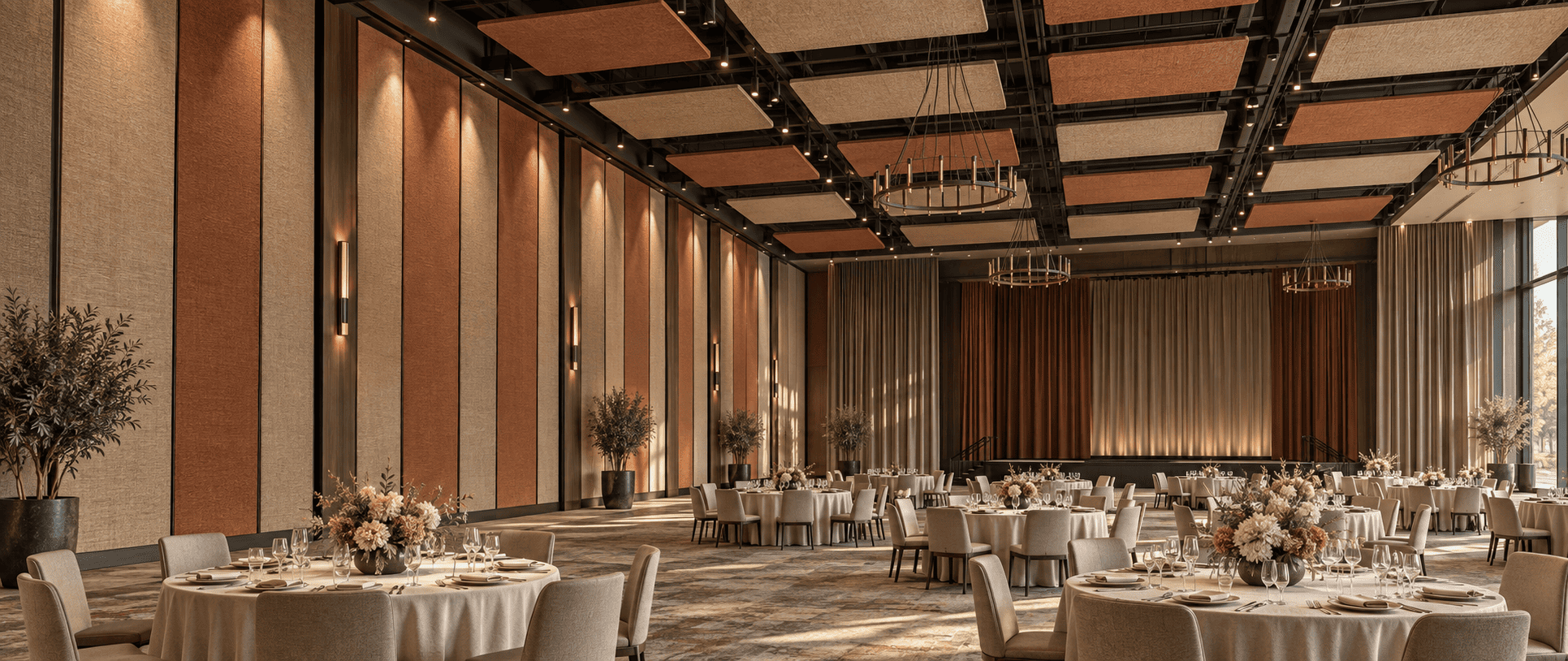
A fabric wrapped panel is not fabric doing the work. The fabric is an acoustically transparent skin over a high-density rockwool core, and the core converts sound energy into a very small amount of heat as air is forced through the fibre. Change the core and you change the panel. Change the fabric colour and you change nothing acoustic at all, which is why these panels suit venues: the performance is fixed while the appearance is free.
| Property | Value |
|---|---|
| Core | High-density rockwool, 96 kg/m3 |
| Thickness | 50 mm, suited to large volumes |
| NRC | 0.90, tested to ASTM C423 |
| Panel size | 1200 x 600 mm, customisable |
| Finish | Over 20 fabric colours and textures |
The 50 mm thickness matters more than the headline NRC. A thinner panel still reads well on a certificate because NRC is an average, but it gives up the lower mid-range, which is where a full hall of people talking actually lives. Wall-mounted panels along the dining flanks, beside cineplex seating and around the stage do most of the work.
When is pre-laminated fabric over foam the better answer?
Not every surface justifies a 50 mm rockwool panel. Pre-laminated acoustic fabric, where the finish fabric is bonded directly onto an acoustic foam backing, reaches NRC 0.80 in a much thinner and lighter build. On a plasterboard soffit, a curved bulkhead or a partition that cannot carry the weight and depth of a framed panel, it is the sensible choice, and it suits speech-dominated seminar rooms and pre-function areas well.
What it will not do is control a bass-heavy sangeet. Do not specify it for the main hall and expect the subwoofer to behave.
What do acoustic curtains do that a fixed panel cannot?
A panel is permanent. A venue is not. Acoustic curtains at 4500 GSM give you STC 30 and add NRC 0.20, and in field use they take out roughly 80 per cent of the traffic noise arriving through a glazed facade. More usefully, they can be drawn or opened between events, so the same hall can be made deader for a conference and opened up for a reception.
They earn their place in three positions: as a stage backdrop, beside a projector screen where you do not want a first reflection landing back on the audience, and as a soft partition when a large hall is split in two. The light blocking is a genuine second function, and it is what makes daytime screenings workable.
Absorption alone will not stop the hall next door
This is where most venue projects go wrong. Every panel discussed so far reduces the sound bouncing around inside the room. None of them stops sound arriving from outside it. If Hall A and Hall B share a gypsum partition, treating both rooms with fabric will not stop the DJ in A reaching the conference in B. Blocking is a mass problem, solved inside the construction, before any finish goes on.
-
Build the barrier first
SoundBlanket mass loaded vinyl goes behind the wall finish, at STC 30 for the 2.5 mm grade and STC 34 for the 4 mm grade. It is limp and dense at 2100 kg/m3, so it adds transmission loss without adding stiffness. The 32 x 4 ft rolls let you run a partition with few joints, and every joint you avoid is a leak you never have to chase.
-
Deal with the low end while the cavity is open
BassBloc is concealed within the build-up at NRC 0.85 to 0.95, absorbing low-frequency energy from music systems and event vibration that thin surface finishes ignore. Once the boarding is closed, this option is gone.
-
Finish with the fabric layer
Panels and curtains go on last. They control echo and set the visual character of the hall, and being surface-mounted they can be recovered in a refurbishment without touching the isolation underneath.
A Delhi banquet hall, 2.4 seconds down to 1.2
A five-star hotel in Delhi had the standard complaint: the hall was unusable for conferences and merely tolerable for weddings, with a measured reverberation time of 2.4 seconds. SoundBlanket MLV at 4 mm, STC 34, went behind the gypsum partitions. Fabric wrapped panels at NRC 0.90 were installed in muted shades chosen by the hotel's designer, and acoustic curtains were integrated so the stage end could be reconfigured event by event.
Reverberation time came down to 1.2 seconds. Speech intelligibility improved enough that the house system could be run at a lower level, and music held together instead of smearing. Nothing about the result was exotic: a correctly built barrier, enough absorbed area, and a reconfigurable stage wall.
Public assembly venues are inspected. Every fabric system in a hall or cineplex should be Class A fire-rated and certified to the relevant ASTM, EN and ISO standards, with the absorption figure traceable to an ASTM C423 test report rather than a brochure claim. Ask for it at specification stage, not at handover.
Where to start on your own venue
Clap in the empty room and listen, then do the same with the room half full of chairs and linen. If the difference is large, you are relying on soft furnishings that will not be there for every event. Measure the hard surface area you can realistically cover, usually the upper wall band above head height plus the rear wall, and start there rather than scattering panels evenly.
Decide early whether you have an isolation problem as well as an echo problem, because that changes the construction, not the finish, and cannot be retrofitted cheaply. Choose fabrics last, when the acoustic outcome is already fixed and the designer can pick freely without anyone arguing about performance.
Products used in this article
Specifications and technical data on each product page. Smaller quantities ship from our online store.
- Fabric Wrapped Acoustic Panels NRC 0.90, 50 mm rockwool core
- SoundBlanket Soundproof Curtains 4500 GSM, STC 30, NRC 0.20
- SoundBlanket Mass Loaded Vinyl STC 30 at 2.5 mm, STC 34 at 4 mm
- BassBloc Sound Absorber NRC 0.85 to 0.95, behind the wall finish
- Acoustic Foam, Galaxy, Pyramid and Curve NRC 0.90, 6 x 3 ft sheets or 1 x 1 ft tiles
Visit Online Store opens mmtacoustixonline.com in a new tab. For project quantities, BOQ support or export orders, use the quote form.